
Written by a Caring Mom at Infant Pamper
Hearing your baby’s heartbeat during an ultrasound is exciting, but seeing 170 beats per minute (bpm) can also make you worry. You may immediately wonder, baby heart rate 170 is that too high?
Not always. A fetal heart rate of 170 bpm can be normal in early pregnancy, especially around 9–10 weeks when your baby’s heartbeat naturally becomes faster before gradually slowing later.
Your doctor will also consider how many weeks pregnant you are, whether your baby was moving, and whether the faster rate was brief or persistent. So, 170 bpm alone doesn’t tell the whole story gestational age and the overall heart-rate pattern matter too.
Table of Contents
- Baby Heart Rate 170 Is That Too High?
- How Fetal Heart Rate Changes During Early Pregnancy
- Normal Fetal Heart Rate Range During Pregnancy
- Brief and Persistent Heart Rates of 170 BPM
- Reasons a Baby’s Heart Rate May Be Faster
- Fetal Tachycardia During Pregnancy
- How Doctors Evaluate a Faster Fetal Heart Rate
- FAQs About a Baby Heart Rate of 170
- Final Thoughts
- Medical Disclaimer
Baby Heart Rate 170 Is That Too High?
A fetal heart rate of 170 bpm does not automatically mean something is wrong.
Gestational age is especially important. During early pregnancy, the baby’s heartbeat naturally becomes faster as the heart develops. ISUOG guidance explains that fetal cardiac activity can usually be seen from around 5–6 weeks, with the heart rate increasing until approximately 10 weeks.
Around 10 weeks, the mean heart rate is approximately 171 bpm. After this early peak, it gradually decreases as pregnancy progresses.
So, if your baby’s heart rate is 170 around 9–10 weeks, the number may be appropriate for that stage of pregnancy.
A persistent rate of 170 later in pregnancy, however, may be interpreted differently. Your healthcare provider will look at the complete heart-rate pattern rather than deciding whether something is wrong from one reading.
How Fetal Heart Rate Changes During Early Pregnancy
Your baby’s heart rate changes quickly during the first trimester. After cardiac activity becomes detectable, the heartbeat speeds up over the next few weeks, reaches its highest levels around 9–10 weeks, and then gradually begins to slow.
Research has found fetal heart rates rising from around 110 bpm in very early pregnancy to about 170 bpm around nine weeks. This is why the normal fetal heart rate should always be considered together with gestational age rather than judged by one number alone.
170 BPM at 8 Weeks
At eight weeks, your baby’s heartbeat is still in a period of rapid change. A rate around 170 bpm can occur during this stage, and your doctor will usually interpret it alongside ultrasound measurements and your estimated pregnancy dates.
170 BPM at 9 Weeks
Around nine weeks, a heart rate of 170 bpm can be expected in healthy pregnancies. One published study reported an average of approximately 170 bpm at this stage, when the fetal heart rate is close to its early-pregnancy peak.
170 BPM at 10 Weeks
A rate near 170 bpm can also occur at ten weeks. ISUOG guidance reports an average of about 171 bpm around this stage. After reaching this early peak, the heart rate generally starts to decrease as pregnancy progresses.
So, if your ultrasound shows 170 bpm at 8, 9, or 10 weeks, the pregnancy week matters just as much as the number itself. Your healthcare provider can interpret the reading alongside your baby’s measurements and the rest of the ultrasound findings.
Normal Fetal Heart Rate Range During Pregnancy
Depending on your stage of pregnancy and depending on how fetal heartbeat is monitored, the normal range of fetal heart rate can be different. This is the reason why there can be some variations in numbers found while searching for the topic in the internet.
During early pregnancy, the fetal heart rate rises significantly and may reach the level of 160 or 170 bpm by the 9–10 week of pregnancy only to decrease afterwards. ISUOG categorizes the normal fetal heart rate in the range of approximately 110–180 bpm and when it goes above 180 bpm, it is referred to as fetal tachycardia.
During later stages of pregnancy, the normal fetal heart rate of around 120–160 bpm is typically expected. The average range of fetal heart rate during labor is 110–160 bpm. Your healthcare provider considers the present week of your pregnancy, how long the elevated fetal heart rate has been registered and the entire pattern of your fetal heart rate while interpreting your fetal heart rate.
Research published by PubMed Central (PMC) also discusses how defining a single normal fetal heart rate range can be more complex than relying on one fixed number.
Brief and Persistent Heart Rates of 170 BPM
The observation of fetal heart rate at 170 BPM does not have to mean a fetal heart rate at 170 BPM.
One should make this distinction.
The heart rates fluctuate with activity. A temporary rise may appear while the baby is in motion and then go back.
A steady increase in heart rate should be evaluated because the health professionals must try to understand why the heart rate is so high.
In case of having observed 170 during the visit, you need to ask whether it was just a quick reading or the heart rate was high at baseline.
That small question can give you much more useful information than the number alone. Research available through PubMed Central (PMC) has also examined mild fetal tachycardia and how fetal heart rate patterns are evaluated.
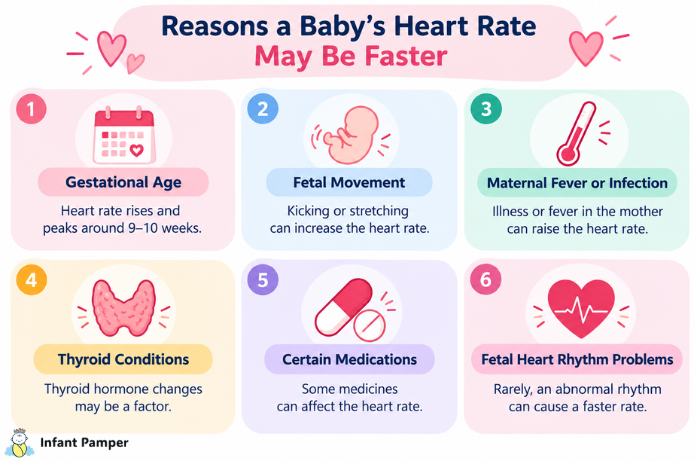
Reasons a Baby’s Heart Rate May Be Faster
A baby’s heartbeat can become faster for several reasons. Sometimes it is simply related to normal development or movement, while a heart rate that stays unusually fast may need a closer look.
Gestational Age
Fetal heart rate naturally rises during early pregnancy and reaches its highest levels around 9–10 weeks. This is why a reading of 170 bpm at nine weeks may be interpreted differently from the same reading later in pregnancy.
Fetal Movement
Your baby’s heart rate may temporarily increase when they kick, stretch, or move during an ultrasound or monitoring session. Doctors usually look at the overall pattern and whether the rate settles again rather than focusing on one brief increase.
Maternal Fever or Infection
A fever, infection, or other maternal illness can sometimes contribute to a faster fetal heartbeat. If you feel unwell or have a fever when a higher heart rate is detected, let your healthcare provider know.
Thyroid Conditions
Abnormal thyroid hormone levels in the mother are another possible factor doctors may consider when a baby’s heart rate remains elevated. A single 170 bpm reading, however, does not mean you have a thyroid condition.
Certain Medications
Some medications can affect your baby’s heart rate. Tell your doctor about prescription medicines, over-the-counter products, and other treatments you use, but never stop prescribed medication without medical advice.
Fetal Heart Rhythm Problems
Less commonly, a persistently fast heartbeat may be caused by an abnormal rhythm such as supraventricular tachycardia (SVT). ISUOG notes that a common type of fetal SVT typically produces rates of about 180–300 bpm, while Great Ormond Street Hospital explains that significant fetal tachycardias may be above 200 bpm.
These rhythm problems are different from simply seeing 170 bpm once during an early-pregnancy ultrasound. If the heartbeat remains unusually fast or the rhythm looks irregular, your healthcare provider may recommend further evaluation.
Fetal Tachycardia During Pregnancy
Fetal tachycardia means the baby’s heart is beating faster than expected.
ISUOG describes fetal tachycardia as a heart rate above 180 bpm in its patient information. In other clinical settings, such as labor monitoring, different thresholds may be used when evaluating the baseline fetal heart rate.
There are also different types of fetal tachycardia.
Sometimes the baby’s normal pacemaker is simply producing a faster rhythm because of another factor, such as maternal illness. In other cases, an abnormal electrical rhythm within the baby’s heart may be responsible.
A reading of 170 by itself isn’t enough to diagnose either situation.
Your healthcare provider needs to consider the rhythm, duration, gestational age, and other clinical findings. Cleveland Clinic also provides helpful information about fetal tachycardia, including possible causes, diagnosis, and treatment.
How Doctors Evaluate a Faster Fetal Heart Rate
When a higher baby heart rate during pregnancy is detected, your healthcare provider may first continue monitoring to see whether the rate settles.
If it remains faster than expected, they may look more closely at the rhythm and your baby’s heart.
Depending on the situation, your healthcare team may review your pregnancy dates, ask about illness or fever, discuss medications, assess the baby’s heart anatomy, or arrange another ultrasound.
Persistent or unusual rhythms may lead to a fetal echocardiogram.
Fetal Echocardiogram
A fetal echocardiogram is a detailed ultrasound examination specifically focused on your baby’s heart.
It allows specialists to look closely at the structure, rhythm, and function of the developing heart.
Being referred for a fetal echocardiogram doesn’t automatically mean a serious heart problem has been found. Sometimes your healthcare team simply needs a clearer view or more detailed information about a rhythm noticed during routine monitoring.
Treatment for Persistent Fetal Tachycardia
A brief reading of 170 bpm does not usually mean treatment is needed. If doctors confirm a persistent abnormal heart rhythm, the next steps depend on the type of rhythm, how fast and how often it occurs, the stage of pregnancy, and how well the baby’s heart is functioning.
Some babies may only need regular monitoring. In certain cases, doctors may give medication to the mother that crosses the placenta and helps manage the baby’s heart rhythm.
Persistent fetal tachycardia is usually monitored and treated by specialists who can decide the safest approach for both mother and baby.
Questions to Ask After a 170 BPM Reading
If you leave your ultrasound remembering only the number 170, it’s easy to worry about it later.
Before you start comparing your baby’s heartbeat with other pregnancy stories online, ask your healthcare provider:
- Is 170 appropriate for my current pregnancy week?
- Was 170 a brief reading or the baseline heart rate?
- Was my baby moving when it increased?
- Was the rhythm regular?
- Did the baby’s heart structure look reassuring?
- Do you want to check the heart rate again?
- Is any additional monitoring needed?
The answers to these questions tell you far more than the number itself.
Home Dopplers and Fetal Heart Rate
A home fetal Doppler may seem like an easy way to check your baby’s heartbeat again, especially after an appointment that left you worried.
But home Dopplers have important limitations.
Finding a heartbeat at home doesn’t evaluate the complete fetal heart-rate pattern or tell you whether your baby is well. It is also possible to confuse your own pulse with the baby’s heartbeat or become anxious when you can’t immediately locate the heartbeat.
Later in pregnancy, if you’re worried about a change in your baby’s usual movements or something doesn’t feel right, contact your maternity-care team rather than relying on a home Doppler for reassurance.
FAQs About a Baby Heart Rate of 170
Final Thoughts
So, baby heart rate 170 is that too high? Not necessarily. A heart rate around 170 bpm can be normal around 9–10 weeks, while later in pregnancy your healthcare provider may look more closely at whether the faster rate was brief or persistent.
Remember, one number doesn’t tell the whole story. Your pregnancy week, your baby’s movement and rhythm, and the overall ultrasound findings all help your doctor understand what the reading means.
If you’re still worried about 170 bpm after your appointment, talk with your doctor or midwife. Getting an explanation based on your own pregnancy is far more helpful than comparing your baby’s heartbeat with numbers online.
Looking for more trusted pregnancy and baby-care guidance? Explore more helpful tips and resources from Infant Pamper to feel informed and supported throughout your parenting journey.
Medical Disclaimer
This article is for informational purposes only and is not a substitute for medical advice. Always speak with your doctor or midwife if you have concerns about your baby’s heart rate or pregnancy.
About the Author
Geeta Yogi is a parenting writer who shares clear, practical information about pregnancy, fetal development, prenatal milestones, and everyday motherhood. Her writing focuses on helping expecting parents better understand common pregnancy questions while encouraging them to discuss individual medical concerns with their healthcare provider.