Written by a Caring Mom at Infant Pamper
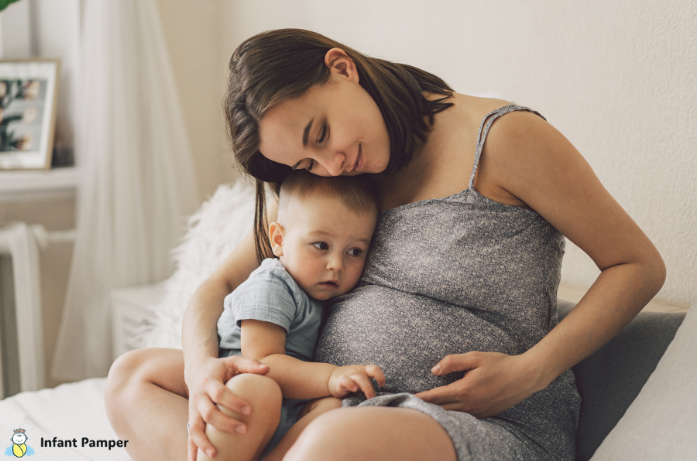
The second positive pregnancy test can feel familiar, but your body may surprise you by changing sooner this time. One common question is, when do you start showing on your second pregnancy?
Many moms notice a small bump around 10 to 14 weeks, sometimes even earlier. Because your abdominal muscles and tissues have already stretched before, your belly may become noticeable sooner than it did during your first pregnancy.
Still, every pregnancy is different. Your body shape, height, bloating, muscle tone, and uterine position can all affect when your bump starts to show.
Table of Contents
- When Do You Start Showing on Your Second Pregnancy?
- Why Does Your Second Pregnancy Show Earlier?
- Baby Bump or Pregnancy Bloating?
- Second Pregnancy Bump Week by Week
- Why One Mom Shows at 10 Weeks and Another at 16
- What If You’re Not Showing Early?
- When Should You Start Wearing Maternity Clothes?
- The Emotional Side of Showing Earlier
- When to Call Your Healthcare Provider
- FAQs About Showing During a Second Pregnancy
When Do You Start Showing on Your Second Pregnancy?
Many second-time moms begin noticing changes toward the end of the first trimester or the beginning of the second trimester.
Around 10 to 14 weeks is a common time for the belly to start looking more consistently pregnant. Some women notice a small curve around 8 or 9 weeks, while others may not have an obvious bump until 15 or 16 weeks.
Cleveland Clinic doctors have also explained that women in later pregnancies may begin showing around 12 to 14 weeks.
The important thing to remember is that pregnancy doesn’t follow one exact timeline.
A mom with a shorter torso may look pregnant earlier, while another woman at the same week may still easily button her normal jeans.
Both can be completely normal.
Why Does Your Second Pregnancy Show Earlier?
Your body has already made room for a baby once.
During your first pregnancy, your uterus expanded, your skin stretched and your abdominal wall adjusted to support your growing baby.
After birth, your body recovers, but your muscles and supporting tissues do not always return to exactly how they were before pregnancy.
When another pregnancy begins, these tissues may stretch forward more easily.
That is why many moms feel like their body seems to “remember” pregnancy the second time around.
Your Abdominal Muscles May Be More Relaxed
Your abdominal muscles help support your growing uterus.
After carrying a baby, they may remain slightly more relaxed than they were before your first pregnancy.
As your uterus grows again, your belly may therefore become noticeable a little sooner.
Some moms especially notice a soft curve in the lower belly during the first trimester.
Your Uterus Has Already Expanded Before
Your uterus changes dramatically during pregnancy.
It grows from a relatively small organ into one capable of supporting a full-term baby.
During a second pregnancy, your uterus and surrounding tissues have already gone through this stretching process.
That doesn’t mean your uterus grows unusually fast. It simply means your body has experienced pregnancy before.
Baby Bump or Pregnancy Bloating?
In the early weeks, it can be hard to tell whether the roundness you see is a true baby bump or just pregnancy bloating. Hormonal changes, especially higher progesterone levels, can slow digestion and lead to gas, constipation, and a fuller-looking stomach.
That is why your belly may look flatter in the morning and noticeably bigger after meals or later in the day. At 7, 8, or 9 weeks, much of that fullness is often caused by bloating, while your uterus is still growing low in the pelvis.
As the weeks pass, a true pregnancy bump usually becomes more consistent and does not disappear overnight. By the end of the first trimester or early second trimester, the growing uterus begins to make the belly look more steadily rounded.
How Can You Tell the Difference?
Bloating often changes throughout the day.
You may look flatter in the morning and much rounder after meals or in the evening.
A developing pregnancy bump usually becomes more consistent as the weeks pass.
Eventually that lower-belly roundness stays around even first thing in the morning.
And honestly, you don’t need to worry too much about deciding which part is baby and which part is bloating. Your body is changing because of pregnancy either way.
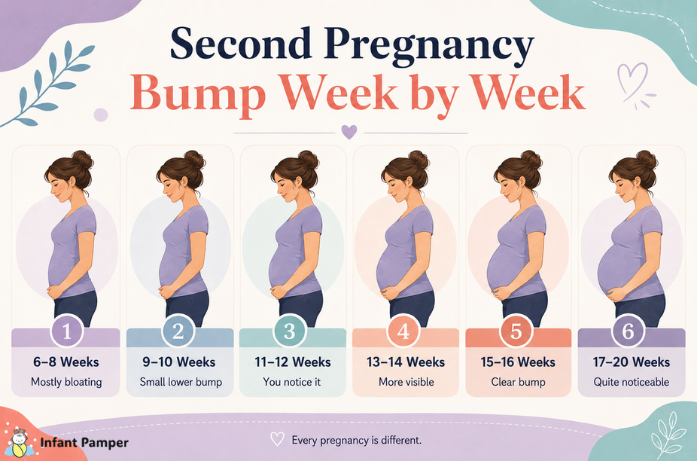
Second Pregnancy Bump Week by Week
Every pregnancy is different, but a simple timeline can help you understand what may be happening.
6 to 8 Weeks
Your baby is still very small at this stage.
If your belly already looks fuller, bloating is probably doing much of the work.
You might still notice that your waist feels thicker or your trousers become uncomfortable after meals.
Second-time moms also tend to notice small body changes earlier simply because they know what pregnancy feels like.
9 to 10 Weeks
You may begin seeing a soft roundness in your lower belly.
It might still be more noticeable in the evening than in the morning.
This is often when stretchy trousers and leggings suddenly start feeling much more comfortable.
11 to 12 Weeks
For some moms, the bump begins looking a little more convincing.
Other people may not notice yet, but you probably do.
Your usual clothes might still fit, although waistbands can begin feeling uncomfortable.
13 to 14 Weeks
This is a common time for the second-pregnancy belly to become more noticeable.
Your uterus is moving higher, and that little lower-belly curve may start looking more like a true pregnancy bump.
Still, don’t worry if your belly hasn’t changed much yet.
As your pregnancy progresses, your baby and uterus continue growing week by week. The American College of Obstetricians and Gynecologists (ACOG) provides a helpful guide to how fetal development changes throughout pregnancy, which can help you understand what is happening inside your growing belly.
15 to 16 Weeks
By this stage, many second-time moms notice a clearer pregnancy shape.
You may also find that hiding the pregnancy under normal clothing becomes harder.
This is often when maternity clothes start becoming more appealing.
17 to 20 Weeks
For many women, the pregnancy is quite noticeable now. Your belly continues growing as your uterus expands, and you may also begin recognizing those exciting first little baby movements.
According to the U.S. Office on Women’s Health, the abdomen continues expanding during the second trimester as your baby grows, and you may also begin noticing baby movements during these months. Every pregnancy develops a little differently, so your bump may not look exactly like someone else’s at the same stage.
Why One Mom Shows at 10 Weeks and Another at 16
Pregnancy bellies can look completely different even when two women have the same due date.
Several things influence when your bump becomes noticeable.
1. Height and Torso Length
A woman with a shorter torso has less room for the uterus to expand upward.
Her belly may therefore appear to grow outward sooner.
A taller woman or someone with a longer torso may not look pregnant quite as early.
2. Natural Body Shape
Your body shape also influences when pregnancy becomes visible.
Some women naturally carry more weight around their middle, while others have a more noticeable bump early.
Neither tells you whether a pregnancy is healthier.
3. Abdominal Muscle Tone
The condition of your abdominal muscles after your first pregnancy can affect how soon your belly rounds forward.
Some women regain more muscle firmness between pregnancies, while others remain more relaxed.
Both situations can be normal.
4. Pregnancy Spacing
If your pregnancies are fairly close together, your abdominal muscles and connective tissues may still be recovering from your first pregnancy.
Some moms therefore notice their second belly sooner.
Still, pregnancy spacing alone cannot predict exactly when you will show.
Does Showing Early Mean Twins?
Showing early does not necessarily mean you are carrying twins. Bloating, body shape, relaxed abdominal muscles, and a previous pregnancy can all make your belly look bigger sooner.
Only an ultrasound can confirm whether you are expecting one baby or twins.
What If You’re Not Showing Early?
It’s easy to worry if you expected to show earlier with your second pregnancy but still don’t have much of a bump by 14 or 15 weeks. The good news is that this can still be completely normal.
Your torso length, body shape, abdominal muscle tone, and the way your uterus is positioned can all affect how soon your belly becomes noticeable. Some healthy pregnancies simply stay less visible for longer.
What matters most is how your pregnancy is progressing at prenatal checkups. If your healthcare provider is happy with your baby’s growth and development, there is usually no reason to compare your bump with someone else’s.
When Should You Start Wearing Maternity Clothes?
Whenever your normal clothes stop feeling comfortable.
There is no special pregnancy week when you’re officially supposed to switch to maternity clothes.
If your jeans are digging into your stomach at 9 weeks, wear something softer.
If your regular clothes still feel perfectly comfortable at 17 weeks, you can keep wearing them.
Comfort matters more than the number on your pregnancy calendar.
Simple Comfort Tips
Try stretchy trousers or leggings.
Loose dresses and longer tops can give your belly more room.
A belly band can sometimes help you keep wearing your regular trousers a little longer.
And if you saved your maternity clothes from your first pregnancy, don’t feel like you need permission to bring them out early.
The Emotional Side of Showing Earlier
Seeing your second pregnancy bump can bring surprisingly mixed feelings.
With your first baby, you may have waited impatiently for your belly to appear.
With your second, you might suddenly notice it while chasing a toddler, folding laundry or getting ready for another busy morning.
Then you look sideways in the mirror and think, “Wow, this is really happening again.”
Some moms feel excited.
Some feel nervous because they aren’t ready for other people to notice.
Others feel emotional about their body changing again, especially if they only recently started feeling comfortable after their previous pregnancy.
All of these feelings are okay.
You can love your growing baby without loving every physical change that comes with pregnancy.
When to Call Your Healthcare Provider
Showing earlier on its own is usually not a reason to worry.
Still, contact your healthcare provider if belly changes happen with concerning symptoms such as significant or persistent abdominal pain, vaginal bleeding, leaking fluid, fever or severe cramping.
You should also bring up any concerns about your baby’s growth or your changing belly during prenatal visits.
Sometimes a quick conversation with someone who understands your pregnancy history can give you the reassurance you need.
FAQs About Showing During a Second Pregnancy
1. When do you start to show in a second pregnancy?
Many moms begin noticing a small bump around 10 to 14 weeks, though showing earlier or later can still be normal.
2. When do you start showing with second pregnancy?
You may show a little earlier than you did with your first baby because your abdominal muscles and tissues have already stretched before.
3. When do you start showing second pregnancy?
Some second-time moms notice changes before 12 weeks, while others may not have an obvious bump until 15 or 16 weeks.
4. Can you show at 8 weeks with your second baby?
Yes, but much of the fullness at 8 weeks may come from pregnancy bloating rather than the baby bump alone.
5. Why am I showing at 10 weeks with my second pregnancy?
Previous stretching of the abdominal muscles, bloating and your natural body shape can all make your belly look noticeable around 10 weeks.
Final Thoughts
For many moms, a second pregnancy bump may become noticeable around 10 to 14 weeks, but the timing can vary based on abdominal muscle tone, body shape, bloating, torso length, and how your body carries the pregnancy. Showing earlier does not automatically mean your baby is bigger or that anything is unusual.
What matters most is how your pregnancy is progressing at prenatal visits, not how quickly your belly appears. Try to stay comfortable, avoid comparing your bump with other moms, and speak with your healthcare provider if you have concerns about growth, pain, bleeding, or any other unusual symptoms.
Every pregnancy journey is different, and having the right information can make it feel a little easier. Explore more helpful pregnancy, baby care, and parenting guides on Infant Pamper to feel informed and supported at every stage.
Disclaimer
This article is for general informational purposes only and is not a substitute for professional medical advice. Always speak with your healthcare provider if you have concerns about your pregnancy, symptoms, or baby’s growth.