Written by a caring mom at Infant Pamper
If your baby has been extra fussy, struggling with gas, eczema, reflux, or mucus in the stool, you may be wondering if dairy could be part of the problem. Trying a dairy-free breastfeeding diet can feel like a big step, especially when you are already tired, hungry, and caring for a baby around the clock.
The good news is that if dairy is bothering your little one, making a few simple changes to your meals may help. In this guide, we’ll walk through what a dairy-free breastfeeding diet looks like, what to eat, what to avoid, and how to start safely without making mealtimes more stressful.
What Is a Dairy-Free Breastfeeding Diet?
A dairy-free diet while breastfeeding means eliminating cow’s milk-based dairy products from your diet. This includes obvious dairy items like milk, cheese, yogurt, butter, cream, paneer (cottage cheese), and ice cream. It can also include hidden dairy ingredients found in packaged foods such as crackers, biscuits, sauces, protein bars, bread, and baked goods.
Some breastfeeding mothers try this when their baby shows signs of a potential sensitivity to cow’s milk protein. Trace amounts of dairy protein can sometimes pass into breast milk, causing digestive issues, skin irritation, or changes in stool in some babies. While this is not always the cause, pediatricians may suggest considering it if symptoms persist.
Some research also suggests that cow’s milk protein allergy can be linked with digestive and skin symptoms in some babies, which is why pediatricians may sometimes recommend a short dairy elimination trial when symptoms persist.
However, not every breastfeeding mother needs to avoid dairy. If your baby is healthy, growing well, and showing no signs of problems, there is generally no reason to give up dairy merely as a precaution. You should usually consider trying a dairy-free diet only when there is a valid reason to do so.
Why Some Moms Try a Dairy Free Diet Breastfeeding Approach
Newborn life can make everything feel blurry. Babies cry, spit up, get gassy, and have all kinds of poop changes, so it’s not always easy to know when something is worth investigating. Still, there are a few signs that may lead a doctor to suggest a dairy free diet breastfeeding trial.
1. Ongoing tummy discomfort
If your baby seems very uncomfortable after feeds, pulls their legs up, arches their back, grunts often, or has persistent gas that doesn’t settle with time, dairy may be one possibility to discuss.
2. Mucus or blood in stool
This is often one of the biggest reasons families look more closely at feeding triggers. It can have several causes, but cow’s milk protein sensitivity is one possibility doctors may want to rule out.
3. Eczema or recurring skin flares
Not all eczema is food-related, but for some babies with suspected sensitivities, skin symptoms may improve when dairy is removed.
4. Reflux-like symptoms
Frequent spit-up, discomfort during or after feeds, or a baby who seems miserable after eating can sometimes overlap with dairy sensitivity symptoms.
5. Strong family history of allergies
If there is a family history of eczema, asthma, food allergies, or digestive sensitivities, your doctor may be more open to trying an elimination diet if your baby has symptoms.
The important thing to remember is that these symptoms can also be caused by many other common baby issues. That’s why it’s always worth checking in with your pediatrician before making major changes to your diet.
How to Start a Dairy-Free Breastfeeding Diet Safely
Starting a dairy free diet for breastfeeding does not need to mean panic-cleaning your pantry or surviving on plain rice. It helps to take it step by step.
1. Talk to your pediatrician first
If your baby has blood in the stool, poor weight gain, severe eczema, or intense reflux, it’s best not to guess your way through it. Your pediatrician can help you decide whether dairy is worth eliminating and whether anything else should be checked too.
2. Remove all obvious dairy
Start with the dairy foods you eat most often: milk, cheese, yogurt, butter, cream, paneer, and ice cream. If your provider advises you to avoid ghee as well, remove that too.
3. Read labels for hidden dairy
This is the part that surprises most moms. Dairy can hide in foods that don’t seem dairy-based at all. Check ingredient lists for words like casein, whey, milk solids, skim milk powder, lactose, butterfat, curds, and milk protein.
If you are feeling unsure about label reading, a simple dairy-free food list like this one from Johns Hopkins Medicine can make grocery shopping much easier.
4. Give it time
A dairy-free trial is rarely something you can judge after one or two days. Some babies improve within a week, but many need 2 to 4 weeks before changes become clearer. That waiting period can feel long when you’re exhausted, but it matters.
5. Keep meals simple
In the beginning, focus on naturally dairy-free meals instead of trying to replace every dairy food right away. Rice, dal, eggs, oats, fruits, vegetables, chicken, beans, potatoes, and dairy-free milk alternatives can carry you through the first few weeks just fine.
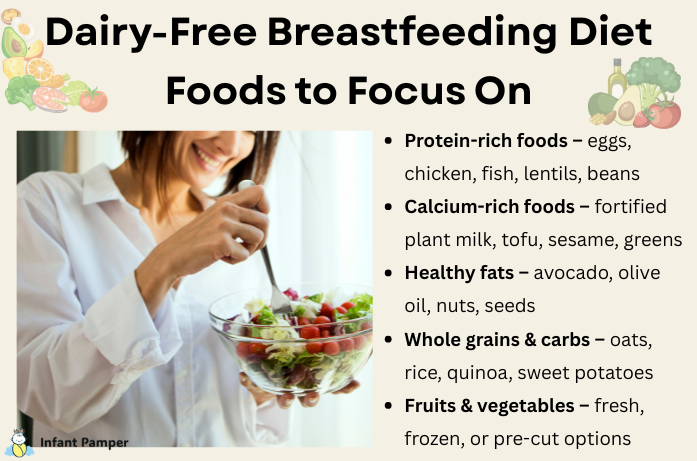
Dairy-Free Breastfeeding Diet Foods to Focus On
A dairy-free breastfeeding diet can still be simple, filling, and nourishing. Focus on easy meals with enough protein, calcium, and healthy fats to support you while nursing.
Protein-rich foods
Breastfeeding hunger is no joke, and protein helps meals feel more satisfying. Try eggs, chicken, fish, lentils, beans, chickpeas, tofu if you eat soy, and nut butters if they work for you.
Calcium-rich non-dairy foods
Since dairy is a big calcium source for many moms, this is something to pay attention to. Good options include fortified oat milk or almond milk, sesame seeds, tahini, tofu made with calcium, white beans, leafy greens, chia seeds, and canned salmon with bones if you eat fish.
Healthy fats
Avocado, olive oil, nuts, seeds, coconut milk, and nut butters can help keep your meals satisfying and support your energy while breastfeeding.
Whole grains and easy carbs
Oats, rice, quinoa, sweet potatoes, whole grain bread, and pasta can all fit beautifully into a dairy free diet breastfeeding routine. They help keep you full and make meals easier to throw together.
Fruits and vegetables
Fresh produce adds fiber, hydration, and variety. And if cooking feels like too much right now, frozen vegetables and pre-cut fruit still count.
Easy Dairy-Free Breakfast Ideas for Breastfeeding Moms
Breakfast can feel like the hardest meal once dairy is off the table, especially if you’re used to yogurt, cereal with milk, or buttery toast. But there are still plenty of simple options.
Oatmeal with dairy-free milk
Cook oats with oat milk, almond milk, or coconut milk, then top with banana, chia seeds, peanut butter, berries, or cinnamon. It’s warm, comforting, and easy to make half-asleep.
Eggs with toast and fruit
Scrambled eggs, avocado toast, and fruit can make a simple, filling breakfast that actually keeps you going.
Dairy-free smoothies
Blend banana, oats, nut butter, spinach, dairy-free milk, and frozen fruit for a quick breakfast or snack you can sip one-handed while holding the baby.
Overnight oats
If mornings are chaotic, overnight oats can save you. Make them the night before with dairy-free milk, oats, and chia seeds, then grab them straight from the fridge.
Dairy-Free Lunch and Dinner Ideas
Lunch and dinner don’t need to be fancy to work. In fact, the easiest meals are often the ones that make sticking with dairy-free eating feel realistic.
Rice bowl with protein and vegetables
Start with rice or quinoa, add chicken, beans, tofu, or salmon, then top with vegetables and olive oil or tahini dressing.
Dal, rice, and sautéed vegetables
If you enjoy Indian home-style meals, this is one of the easiest naturally dairy-free combinations to lean on. It’s warm, filling, and comforting.
Chicken and veggie soup
Soup is one of the best tired-mom meals. A simple broth-based soup with chicken, carrots, potatoes, rice, or noodles can be gentle and nourishing.
Pasta with olive oil and vegetables
Pasta does not need cheese to feel satisfying. Add garlic, spinach, mushrooms, peas, or shredded chicken for a quick meal that still feels like comfort food.
Baked potatoes with dairy-free toppings
A baked potato topped with beans, avocado, leftover chicken, or sautéed vegetables can be a very easy lunch when you need something warm and filling.
Dairy-Free Snacks for Hungry Breastfeeding Moms
Breastfeeding hunger can hit out of nowhere, so snacks matter more than we sometimes admit. Keeping easy dairy-free options nearby can make the whole process feel less stressful.
A few simple ideas:
- Fruit with peanut butter or almond butter
- Roasted chana or trail mix
- Hummus with crackers or cucumber
- Boiled eggs
- Toast with avocado
- Dairy-free granola bars
- Smoothies or homemade energy bites
- Coconut yogurt if you enjoy it
The goal is not to eat perfectly. The goal is to keep yourself fed enough that you’re not running on coffee and crumbs all day.
Dairy Foods and Ingredients to Avoid
If you’re doing a proper elimination trial, even small amounts of dairy can make it harder to know whether it’s helping. That means label reading becomes part of the process for a while.
Common dairy foods to avoid
Milk, cheese, yogurt, butter, cream, ice cream, paneer, condensed milk, creamy sauces, cheesy snacks, and milk-based soups or desserts.
Common hidden dairy ingredients
Casein, whey, milk solids, skim milk powder, butterfat, curds, lactose, and lactalbumin.
Some packaged foods that surprise moms include biscuits, crackers, chips, cereal bars, instant mashed potatoes, salad dressings, chocolate, and even some breads.
How to Know If the Dairy-Free Diet Is Helping
This can be the most emotionally difficult part, because when your baby is uncomfortable, you want a clear answer right away. But improvement is not always immediate.
If dairy is contributing to your baby’s symptoms, you may notice:
- less fussiness after feeds
- less gas or tummy discomfort
- better stools over time
- less spit-up or reflux discomfort
- calmer skin if eczema was part of the picture
- a more settled baby overall
Sometimes the change is dramatic. Sometimes it’s subtle and gradual. Keeping a simple food and symptom journal can help you notice patterns more clearly.
What If Nothing Changes?
If you’ve removed dairy carefully for a few weeks and nothing is improving, that does not mean you did anything wrong. It may simply mean dairy wasn’t the issue. And honestly, that’s still useful information.
At that point, it’s a good idea to check back in with your pediatrician. They may want to explore reflux, oversupply, latch issues, soy sensitivity, eczema triggers, or simply normal infant behavior. You do not need to keep restricting your diet forever without a clear reason.
Nutrients to Pay Attention to While Breastfeeding Dairy-Free
When moms cut out dairy, the biggest nutrition concerns are usually calcium, vitamin D, and overall calorie intake. The CDC’s breastfeeding nutrition guidance also highlights how important it is for breastfeeding moms to get enough key nutrients through food or supplements when needed.
Try to make sure you’re getting:
- Calcium from fortified dairy-free milks, tofu, beans, greens, tahini, and seeds
- Vitamin D from supplements if recommended by your doctor, sunlight, and fortified foods
- Protein at most meals to help with recovery and hunger
- Healthy fats and carbs so you don’t feel drained all day
If your diet already feels very restricted or you’re losing weight without trying, it may help to speak with a registered dietitian who understands breastfeeding and food intolerances.
Final Thoughts on a Dairy-Free Breastfeeding Diet
A dairy-free breastfeeding diet can feel like a big adjustment at first, especially when you’re already navigating the emotional and physical demands of caring for a baby. But it does get easier. Label reading becomes quicker. Meal ideas become more familiar. Safe snacks become automatic. And if dairy really is affecting your baby, seeing them more comfortable can make the effort feel deeply worth it.
Take it one meal at a time. Keep your own nourishment in mind too. Lean on simple foods, gentle routines, and your pediatrician’s guidance when you need it. Most of all, be kind to yourself through the process. You do not have to do this perfectly to do it well.
You’re feeding your baby, caring for your own body, and making thoughtful choices in a season that already asks so much of you. That matters. And however this dairy-free journey unfolds, you’re doing a beautiful job.
FAQs About a Dairy-Free Breastfeeding Diet
1. Why would I need a dairy-free breastfeeding diet?
Some moms try a dairy-free diet if their baby has symptoms like gas, reflux, eczema, or mucus in the stool and dairy sensitivity is suspected.
2. How long does it take to see results after cutting out dairy?
It can take anywhere from a few days to 2–4 weeks to notice improvement, depending on your baby’s symptoms.
3. What can I eat on a dairy-free breastfeeding diet?
You can eat foods like oats, rice, fruits, vegetables, eggs, chicken, lentils, beans, nuts, and dairy-free milk alternatives.
4. Do I need to stop breastfeeding if my baby is sensitive to dairy?
In most cases, no. Many moms can continue breastfeeding while removing dairy from their own diet if advised by their doctor.
For more gentle feeding advice and mom-to-mom support, read more breastfeeding tips on Infant Pamper.
Disclaimer: This article is for informational purposes only. Please talk to your pediatrician or healthcare provider before making major diet changes while breastfeeding.