
Written with care by a mom at Infant Pamper
How many weeks in a pregnancy? A typical pregnancy lasts about 40 weeks (280 days), counted from the first day of your last menstrual period. However, not every baby arrives exactly at 40 weeks, and a pregnancy is considered full term between 39 weeks and 40 weeks and 6 days.
If you are newly pregnant, you might find counting weeks, months, and trimesters a bit confusing, particularly if your doctor provided a due date that does not correspond to what you were calculating. However, understanding your pregnancy timetable will assist you in feeling more prepared and at ease.
In this guide, we would like to share with you pregnancy weeks by trimester, how to calculate the due date of your pregnancy, at what point it is considered full term and what to do in case your baby comes earlier or later than expected.
How Many Weeks in a Pregnancy?
A typical pregnancy lasts about 40 weeks (280 days), or roughly nine months. However, pregnancy doesn’t start counting from the day you conceive.
Doctors calculate pregnancy from the first day of your last menstrual period (LMP). This is known as gestational age and helps healthcare providers track your baby’s development and estimate your due date.
For example, if your last period started on January 1, your estimated due date would be around October 8, assuming a regular 28-day cycle.
According to Cleveland Clinic, this method is commonly used because the exact date of conception can be difficult to determine.
Remember, your due date is an estimate, not an exact delivery date. Your baby may arrive a little earlier or later, and that’s why doctors monitor your pregnancy throughout the journey.
Why Is Pregnancy Counted From Your Last Period?
This is one pregnancy fact that surprises many moms.
How can you be two weeks pregnant before your baby is even conceived?
In a typical 28-day menstrual cycle, ovulation happens around day 14. Fertilization may occur around this time, but pregnancy counting has already started.
Here’s how the early weeks generally work:
- Week 1: Your menstrual period begins.
- Week 2: Ovulation approaches, and conception may happen.
- Week 3: The fertilized egg may implant in the uterus.
- Week 4: You may miss your period and get a positive pregnancy test.
Not everyone ovulates on day 14, especially women with irregular cycles.
That’s why doctors sometimes use an early ultrasound to confirm how far along you are.
Pregnancy Weeks to Months: Easy Conversion Chart
Most moms find it easier to think about pregnancy in months rather than weeks.
Here’s a simple chart to help you understand both.
| Pregnancy month | Approximate weeks |
| Month 1 | Weeks 1–4 |
| Month 2 | Weeks 5–8 |
| Month 3 | Weeks 9–13 |
| Month 4 | Weeks 14–17 |
| Month 5 | Weeks 18–22 |
| Month 6 | Weeks 23–27 |
| Month 7 | Weeks 28–31 |
| Month 8 | Weeks 32–35 |
| Month 9 | Weeks 36–40 |
Note: These are approximate month ranges. Calendar months aren’t exactly four weeks long, so different pregnancy calendars may show slightly different conversions.
For medical appointments, it’s always better to follow your pregnancy weeks and days.
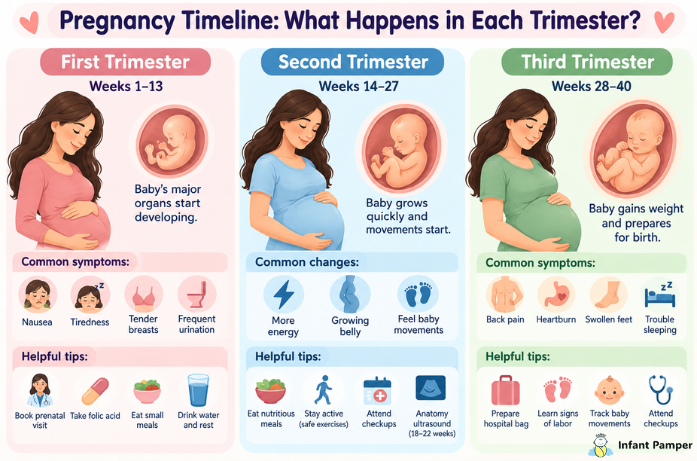
Pregnancy Timeline: What Happens in Each Trimester?
Pregnancy occurs in three trimesters, each one affecting you and your baby in crucial ways. Knowing what to expect during pregnancy can make it much easier for you to track your child’s growth, deal with pregnancy issues, and get ready for delivery.
First Trimester: Weeks 1–13
The first trimester is when your baby’s major organs begin forming, including the brain, heart, and spinal cord. Tiny arms, legs, fingers, and toes also start developing.
During these weeks, you may experience morning sickness, tiredness, tender breasts, and frequent urination. Some moms also experience early pregnancy and loss of appetite, while others notice very few symptoms.
Helpful tips:
- Schedule your first prenatal appointment.
- Take prenatal vitamins with folic acid as recommended.
- Eat small meals to help manage nausea.
- Drink enough water and get plenty of rest.
Your body is going through many changes, so don’t worry if you feel more tired than usual.
Second Trimester: Weeks 14–27
Many moms feel more energetic during the second trimester as nausea and tiredness may improve. Your baby grows quickly, and your belly becomes more noticeable.
You may begin feeling your baby’s first movements between 16 and 24 weeks. These often feel like tiny flutters or bubbles. An anatomy ultrasound is usually offered around 18–22 weeks to check your baby’s development.
Helpful tips:
- Continue regular prenatal checkups.
- Eat nutritious meals rich in iron and calcium.
- Stay active with gentle, pregnancy-safe exercises.
- Start paying attention to your baby’s movements.
If you haven’t felt your baby move by 24 weeks, contact your healthcare provider.
Third Trimester: Week 28 Until Birth
During the third trimester, your baby gains weight, and the lungs and brain continue developing in preparation for birth.
As your belly grows, you may experience back pain, heartburn, swollen feet, and trouble sleeping. Your baby’s movements may also feel stronger.
Helpful tips:
- Prepare your hospital bag and baby essentials.
- Learn the early signs of labor.
- Keep track of your baby’s usual movements.
- Attend all prenatal appointments.
- Rest whenever possible.
If your baby’s movements become less frequent or noticeably change, contact your maternity care team immediately.
As your due date approaches, focus on staying comfortable and preparing for your baby’s arrival. Remember, every pregnancy is different, and your healthcare provider can guide you through each stage.
Is 37 Weeks Pregnant Considered Full Term?
Not exactly, and this is something every expecting mom should understand.
Although babies born at 37 weeks are no longer classified as premature, pregnancy isn’t medically considered full term until 39 weeks.
Here’s how pregnancy is classified:
| Pregnancy stage | Weeks |
| Preterm | Before 37 weeks |
| Early term | 37 weeks to 38 weeks, 6 days |
| Full term | 39 weeks to 40 weeks, 6 days |
| Late term | 41 weeks to 41 weeks, 6 days |
| Postterm | 42 weeks and beyond |
Those final weeks are important because your baby’s lungs, brain, and other organs continue developing.
In an uncomplicated pregnancy, doctors generally avoid scheduling delivery before 39 weeks without a medical reason.
However, certain health conditions may make earlier delivery safer for mom or baby.
How to Calculate Your Pregnancy Due Date
Wondering when you’ll finally meet your little one?
One common method is to count 280 days from the first day of your last menstrual period.
You can also use a calculation called Naegele’s rule.
Example of a Due Date Calculation
Imagine your last menstrual period started on March 1, 2026.
- Add seven days: March 8, 2026.
- Subtract three months: December 8, 2025.
- Add one year: December 8, 2026.
Your estimated due date would be December 8, 2026.
This calculation assumes a regular 28-day menstrual cycle.
The NHS provides a pregnancy due date calculator that also considers menstrual cycle length.
If your periods are irregular or you don’t remember your last period, an early ultrasound can help estimate your due date.
What If You Conceived Through IVF?
Pregnancy dating works slightly differently with in vitro fertilization (IVF).
Because the embryo’s age and transfer date are known, healthcare providers can calculate gestational age using those details.
Your fertility specialist will give you an estimated due date based on your treatment.
Why Your Due Date Might Change After an Ultrasound
Imagine thinking your baby is due on September 10, but after an early ultrasound, your doctor changes it to September 15.
It’s understandable to feel confused.
Your initial due date may have been based on your menstrual cycle, but ovulation doesn’t always happen exactly when expected.
An early dating ultrasound measures your developing baby and helps estimate gestational age.
If the measurements differ enough from your menstrual dates, your healthcare provider may adjust your due date.
Once a reliable due date is established, later ultrasounds usually don’t change it simply because your baby measures slightly bigger or smaller.
What Happens If You Reach 40 Weeks and Baby Hasn’t Arrived?
Reaching your due date without going into labor can feel frustrating.
Your hospital bag is ready, everyone keeps asking whether the baby has arrived, and every little cramp makes you wonder if labor is starting.
But reaching 40 weeks doesn’t automatically mean something is wrong.
According to MedlinePlus, a due date is only an estimate, and healthcare providers may recommend additional monitoring when pregnancy continues beyond the expected date.
What Happens at 41 Weeks?
At 41 weeks, your healthcare provider may recommend additional checks to monitor your baby’s well-being.
These may include monitoring the baby’s heart rate and using ultrasound to assess amniotic fluid.
Your doctor may also discuss induction of labor depending on your health, your baby’s condition, and your preferences.
What Happens at 42 Weeks?
A pregnancy reaching 42 weeks is considered postterm.
At this stage, certain risks increase, including concerns about placental function and reduced amniotic fluid.
Healthcare providers generally recommend planning delivery before pregnancy continues this far.
Never try home methods to start labor without discussing their safety with your maternity care team.
Important Pregnancy Milestones to Remember
There are so many appointments and changes during pregnancy that keeping track can feel overwhelming.
Here’s a quick reference:
| Pregnancy weeks | Common milestone |
| 4–5 weeks | Home pregnancy test may become positive |
| 8–12 weeks | Early prenatal assessment |
| 11–14 weeks | Some first-trimester screening options |
| 18–22 weeks | Anatomy ultrasound |
| 18–24 weeks | Many moms notice baby movements |
| 24–28 weeks | Gestational diabetes screening |
| 28 weeks | Third trimester begins |
| 36–37 weeks | Group B strep screening may be offered |
| 39 weeks | Full-term pregnancy begins |
| 40 weeks | Estimated due date |
These are general milestones. Your appointments and screening schedule may differ depending on your medical history and healthcare provider.
When Should You Contact Your Healthcare Provider?
Not every uncomfortable pregnancy symptom means something is wrong, but certain changes should never be ignored.
Seek medical attention promptly if you experience heavy vaginal bleeding, severe abdominal pain, leaking fluid, a severe headache with vision changes, or noticeably reduced fetal movement once you’ve established your baby’s usual movement pattern.
Don’t wait until your next appointment if something feels concerning.
And remember, you can always ask questions. You don’t need to understand every medical term or manage every worry alone.
Frequently Asked Questions
1. How many weeks normal pregnancy lasts?
A typical pregnancy lasts approximately 40 weeks, counted from the first day of the last menstrual period. However, babies may arrive before or after their estimated due date.
2. How many weeks full pregnancy is considered full term?
Pregnancy is medically considered full term from 39 weeks through 40 weeks and 6 days. Babies born between 37 and 38 weeks are classified as early term.
3. How many weeks is in a normal pregnancy if my periods are irregular?
The standard pregnancy timeline is still around 40 weeks, but estimating your due date from your last period may be less accurate. An early ultrasound can help determine gestational age.
4. How is the trimester in weeks pregnancy timeline divided?
The first trimester covers weeks 1–13, the second covers weeks 14–27, and the third begins at week 28 and continues until birth.
5. Is pregnancy nine months or ten months?
Pregnancy is generally described as nine calendar months. Forty weeks equals ten four-week periods, but calendar months are longer than exactly four weeks.
Final Thoughts
Pregnancy is a special journey, and every week brings you closer to meeting your little one. While a typical pregnancy lasts 40 weeks, your baby may arrive a little earlier or later than your estimated due date.
Every pregnancy is different. Your symptoms, baby’s growth, and delivery timeline may not be the same as another mom’s, and that’s perfectly normal.
The most important thing is to attend regular prenatal checkups, follow your healthcare provider’s advice, and pay attention to your body’s changes throughout pregnancy.
At Infant Pamper, we are here to support you with helpful pregnancy and parenting advice. Take care of yourself, enjoy the little milestones, and remember that each passing week brings you one step closer to holding your baby.
Medical Disclaimer: This article is for general educational purposes and does not replace professional medical advice. Always consult your obstetrician, midwife, or qualified healthcare professional about pregnancy symptoms, due dates, or delivery decisions.