Written by a caring mom at Infant Pamper
Pregnancy can change your skin in ways you may not expect. Your skin may suddenly feel tighter, flakier, itchier, or more sensitive, even if you never struggled with dryness before.
Pregnancy skin dryness can happen because of hormonal changes, stretching skin, changing weather, and increased skin sensitivity. You may notice it on your face, belly, hands, legs, or other areas that start feeling rough or uncomfortable.
The good news is that mild dryness is often manageable with simple, gentle care. Understanding what is causing these changes can help you choose a soothing routine that keeps your skin feeling softer and more comfortable throughout pregnancy.
Table of Contents
- Pregnancy Skin Dryness: Why Does It Happen?
- Where Can Pregnancy Dryness Appear?
- Simple Care Tips for Dry Pregnancy Skin
- What Ingredients Can Help Dry Skin?
- Be Careful With Active Skincare Ingredients
- Dry Skin or Something More? Know the Difference
- When Should You Call Your Doctor?
- FAQs
- Final Thoughts
- Disclaimer
Pregnancy Skin Dryness: Why Does It Happen?
Pregnancy affects your skin as well as the rest of your body. Hormonal changes, increased blood flow, and stretching skin can all change how your skin feels.
A review published through PubMed Central explains that pregnancy causes several hormonal and physical changes that can affect the skin. Some moms may notice oiliness, while others develop dry skin during pregnancy, even if dryness was never an issue before.
Your skin barrier can also become more sensitive, leading to tightness, flaking, or itching. Hot showers, harsh soaps, dry weather, and strong skincare products may make these symptoms worse.
Where Can Pregnancy Dryness Appear?
Dryness can show up almost anywhere, but many moms notice it first on the:
- face
- belly
- legs
- hands
- breasts
- hips
- elbows
Your belly may feel especially tight or itchy as it grows because the skin is stretching.
According to ACOG, pregnancy can also affect existing skin conditions. For example, eczema or atopic dermatitis may improve for some women and become worse for others.
So if your skin feels different from your normal routine, it does not necessarily mean something is wrong.
Why Your Face May Look Different Too
The face often goes through its own changes during pregnancy.
You may notice dryness, sensitivity, breakouts, or darker areas on the forehead, cheeks, or upper lip. These pregnancy face changes are often linked with hormonal shifts.
Johns Hopkins Medicine explains that pregnancy can be associated with acne, increased pigmentation, and melasma, sometimes called the “mask of pregnancy.”
This is one reason sunscreen becomes especially important.
If your face feels dry and sensitive, try not to add too many new products at once. A simple routine is often easier for changing pregnancy skin.
Simple Care Tips for Dry Pregnancy Skin
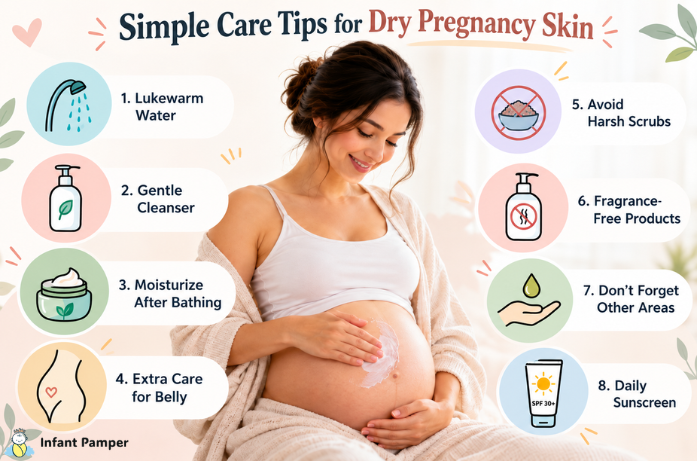
You don’t need a complicated skincare routine to care for dry pregnancy skin. Small, consistent habits can often make your skin feel softer, calmer, and less irritated.
1. Use Lukewarm Water
Long, hot showers may feel relaxing, but they can strip away some of your skin’s natural oils and leave dryness feeling worse.
Choose lukewarm water instead and keep showers reasonably short. This is especially helpful if your belly, legs, or arms already feel tight or itchy.
2. Choose a Gentle, Fragrance-Free Cleanser
Strong soaps and heavily foaming cleansers can sometimes make sensitive skin feel even drier.
Look for a mild, fragrance-free cleanser and avoid scrubbing your skin too hard. ACOG also recommends mild, fragrance-free soaps when pregnancy skin feels itchy.
Your skin should feel comfortable after cleansing not tight or “squeaky clean.”
3. Moisturize While Your Skin Is Still Damp
One of the easiest ways to support dry skin is to apply moisturizer soon after bathing.
Gently pat your skin with a towel, leaving it slightly damp, then apply your cream or lotion. This can help reduce moisture loss and keep the skin feeling softer.
For very dry areas, a thicker cream or ointment may feel more soothing than a lightweight lotion.
4. Give Your Growing Belly Extra Care
As your belly grows, the skin stretches and may start to feel tight or itchy. Johns Hopkins notes that dry, itchy skin can continue as the abdomen expands during pregnancy.
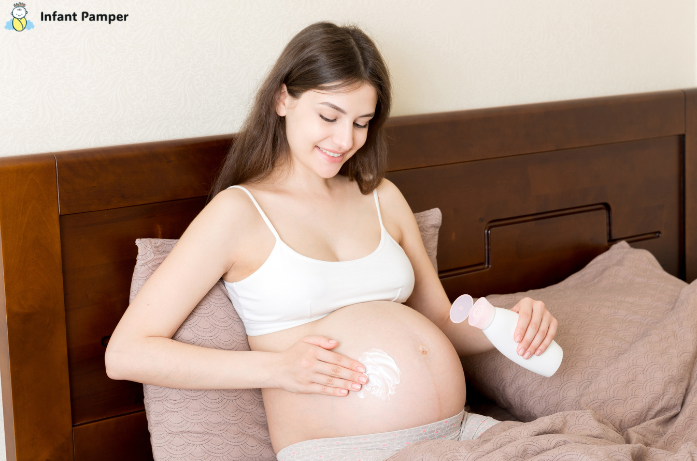
Applying moisturizer once or twice a day can help reduce discomfort. You can use a gentle cream, body butter, or oil if your skin tolerates it well.
Just remember that moisturizing can improve comfort, but it cannot guarantee that stretch marks will not develop. Johns Hopkins explains that no method has been proven to completely prevent or erase stretch marks.
5. Avoid Harsh Scrubs and Over-Exfoliating
Flaky skin can make you want to scrub harder, but this may actually increase irritation.
Avoid rough body scrubs, harsh brushes, and frequent exfoliation when your skin feels sensitive. Johns Hopkins also advises avoiding abrasive scrubs because they may irritate sensitive pregnancy skin.
Gentle cleansing is usually enough while your skin is dry.
6. Choose Fragrance-Free Skincare When Possible
Pregnancy may make your skin more reactive than usual, so strongly scented body washes, lotions, or creams can sometimes feel irritating.
Simple, fragrance-free products are often easier for sensitive skin to tolerate. If a new product causes burning, redness, or worsening itchiness, stop using it and switch back to something gentler.
7. Moisturize the Areas You Usually Forget
Your belly may get most of the attention, but pregnancy dryness can also affect your hands, elbows, breasts, thighs, and legs.
Keep moisturizer somewhere easy to reach and apply it whenever these areas start feeling tight or rough. Regular moisturizing tends to work better than waiting until the skin becomes very uncomfortable.
8. Make Sunscreen Part of Your Morning Routine
Pregnancy can also cause increased pigmentation and darker facial patches. Johns Hopkins recommends sun protection to help reduce pregnancy-related skin darkening.
Use a broad-spectrum sunscreen with at least SPF 30 on your face, neck, and other exposed areas. A hat and shade can provide extra protection when you’re spending more time outdoors.
What Ingredients Can Help Dry Skin?
You don’t need to understand every ingredient on the label.
For dry skin, look for simple products designed to hold moisture and support the skin barrier.
Helpful moisturizing ingredients may include:
- ceramides
- glycerin
- hyaluronic acid
- petrolatum
Ceramides help support the skin barrier, while glycerin and hyaluronic acid help attract moisture. Petrolatum can help reduce water loss from very dry areas.
Bioderma’s pregnancy dryness guidance also emphasizes moisturization and protecting the skin barrier.
The best product is not always the most expensive one.
It is the one your skin tolerates well and that you can use consistently.
Keep Your Pregnancy Skincare Routine Simple
When skin suddenly changes, it can be tempting to buy lots of products.
But pregnancy is a good time to keep things simple.
A basic routine may look like this:
Morning: Gentle cleanse if needed, moisturizer, and sunscreen.
Evening: Remove makeup and sunscreen, cleanse gently, then apply moisturizer.
After showering: Apply body cream to your belly, legs, breasts, arms, and any other dry areas.
That’s often enough.
Your skin does not need ten different serums to feel cared for.
Be Careful With Active Skincare Ingredients
Pregnancy is a good time to take a closer look at the ingredients in your skincare routine, especially if you use acne treatments, anti-aging products, or prescription creams.
Some active ingredients are not recommended during pregnancy. Johns Hopkins Medicine advises avoiding prescription isotretinoin and tretinoin while pregnant.
If you are unsure about a product, check with your obstetrician or dermatologist before using it. And remember, a product labeled “natural” is not automatically safe during pregnancy, so it is always worth checking the ingredient list first.
Dry Skin or Something More? Know the Difference
Mild dryness can certainly make your skin feel itchy during pregnancy, but not every itch is simply caused by dry skin.
According to ACOG, pregnancy can sometimes be linked with conditions such as PUPPP, prurigo of pregnancy, pemphigoid gestationis, and intrahepatic cholestasis of pregnancy (ICP).
PUPPP may cause intensely itchy red bumps or patches, often on the abdomen. Prurigo can appear as small itchy bumps, while pemphigoid gestationis is a rare condition that may cause blisters. ICP is different because it can cause strong itching, sometimes without a visible rash.
A medical review published through PubMed Central also notes that pregnancy-related itching should be properly evaluated when it is severe, unusual, or persistent, since some conditions need medical care.
When Should You Call Your Doctor?
Contact your healthcare provider if your itching:
- becomes severe
- keeps getting worse
- wakes you at night
- comes with a spreading rash
- causes blisters
- feels very different from ordinary dry skin
It is especially important to mention intense itching on the palms of your hands or soles of your feet.
ACOG notes that ICP needs medical monitoring because it can be associated with pregnancy complications.
So if something feels unusual, don’t simply keep changing moisturizers.
Your maternity care provider would much rather answer a question than have you worry at home.
Will Pregnancy Dryness Go Away After Birth?
For many women, pregnancy-related skin changes improve after delivery as hormone levels begin to shift again.
Johns Hopkins explains that changes such as acne and pigmentation often become less noticeable after pregnancy.
The American Pregnancy Association also discusses how pregnancy may temporarily change pigmentation, oil production, stretch marks, and overall skin appearance.
But postpartum skin doesn’t always return to normal immediately.
Your hormones are still changing, your sleep may be different, and your daily routine is completely new with a baby.
Give your skin time. If dryness continues, becomes painful, or causes ongoing irritation, a dermatologist can help check for eczema, dermatitis, or another condition.
FAQs
Final Thoughts
Pregnancy can make your skin feel drier, tighter, or more sensitive than usual, but mild pregnancy skin dryness can often be managed with simple care. Gentle cleansing, regular moisturizing, lukewarm showers, and daily sun protection can help keep your skin more comfortable.
Pay attention to changes that feel different from ordinary dryness. If itching becomes severe, lasts for a long time, affects your palms or soles, or comes with a rash or blisters, speak with your healthcare provider.
At Infant Pamper, we believe pregnancy care should feel simple and reassuring. Give your skin a little extra moisture, patience, and care while your body continues to change.
Disclaimer
This article is for informational purposes only and is not a substitute for medical advice. Always speak with your doctor or healthcare provider if you have concerns about skin changes, itching, or skincare products during pregnancy.
About the Author
Geeta Yogi is a parenting writer who shares practical guidance about pregnancy wellness, skincare changes, maternal self-care, and everyday motherhood. Her writing focuses on helping expecting moms understand common pregnancy changes and care for themselves with simple, realistic routines.