Written by a caring mom at Infant Pamper
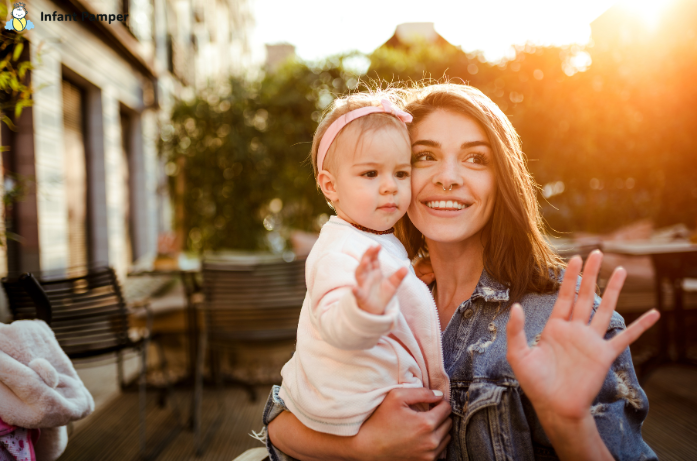
Many babies begin waving between the ages of 8 months and 12 months old. Some babies may wave even earlier while others take longer to wave which is completely normal.
The act of waving for the first time holds a special significance for the baby as well as the parents. Waving is an early form of non-verbal communication used by babies; they watch their parents wave their hands and learn to use gestures for different occasions such as saying goodbye or hello.
In case your baby’s first attempt at waving is not as expected, don’t worry. The way your baby waves may not be typical and may only involve flapping of arms or hands.
Table of Contents
- When Do Babies Start Waving?
- What Does a Baby’s First Wave Look Like?
- A Simple Baby Waving Timeline
- Why Waving Is an Important Developmental Skill
- Signs Your Baby May Be Getting Ready to Wave
- How to Help Your Baby Learn to Wave
- Baby Not Waving at 12 Months: Should You Worry?
- FAQs About Baby Waving
- Final Thoughts
- Disclaimer
When Do Babies Start Waving?
Many babies begin waving around 8 to 12 months, although some may start a little earlier or later. The CDC includes waving “bye-bye” as a communication milestone by 1 year, while ASHA notes that gestures like waving and pointing often develop around 10 to 12 months.
At first, your baby may copy the movement without fully understanding what it means. With repeated everyday moments, such as waving when someone arrives or leaves, they slowly begin to connect the gesture with saying hello or goodbye.
Early waves may look like whole-arm flapping, opening and closing the fingers, or even waving with the palm facing inward. These first attempts do not need to look perfect, and they often become clearer as your baby’s coordination and communication skills grow.
What Does a Baby’s First Wave Look Like?
A first wave may look very different from an adult wave.
Your baby may:
- flap the whole arm
- lift one hand into the air
- open and close the fingers
- rotate the wrist
- wave with the palm facing inward
- use both hands at once
- wave a few seconds after someone leaves
So if you’re waiting for a perfect side-to-side wave, you might accidentally miss the first attempts.
What matters most is whether the movement is starting to happen during a social moment, such as saying hello or goodbye.
A Simple Baby Waving Timeline
Around 6–8 Months
Your baby may start watching your hands more closely.
They might stare when you clap, point, wave, or blow a kiss. They may also begin copying facial expressions, sounds, or simple movements.
At this stage, they may not wave yet, but they’re learning by watching.
Around 8–10 Months
Some babies begin experimenting with wave-like movements.
You may see an arm lift, finger movement, or excited flap when someone says goodbye.
At first, it may seem random. With repetition, the movement often becomes more connected to the situation.
Around 10–12 Months
Waving may become more purposeful.
Your baby might hear “bye-bye” and lift a hand before you even demonstrate the gesture.
This is also a time when other communication gestures may become more noticeable.
Why Waving Is an Important Developmental Skill
The baby waving milestone is more than just a cute trick.
To wave intentionally, your baby needs to notice another person’s action, remember it, try to copy it, and slowly understand that the movement has a social meaning.
So waving involves several areas of development at once:
- communication
- imitation
- social understanding
- memory
- physical coordination
The AAP article explains how babies gradually gain more voluntary arm, hand, and finger control during the first months.
In a simple way, your baby is learning, “When I move my hand like this, people understand me.”
That is a big step toward more purposeful communication.
Imitating a Wave vs. Understanding It
In the beginning, your baby may wave simply because they see you doing it. They watch your hand move, try to copy the action, and slowly begin to understand what it means.
With repeated everyday moments, like waving when someone leaves or saying “bye-bye” at the door, your baby starts connecting the gesture with the situation. Eventually, they may begin waving on their own without waiting for you to do it first.
That little change shows that waving is becoming more than imitation it is starting to become a meaningful way for your baby to communicate.
Signs Your Baby May Be Getting Ready to Wave
There is no exact checklist, but you may notice other communication skills developing around the same period.
Your baby may:
- watch your face during conversation
- turn toward familiar voices
- raise their arms to be picked up
- babble sounds like “bababa” or “mamama”
- copy sounds or facial expressions
- enjoy peekaboo
- reach toward things they want
- react to familiar words
- show or give you objects
- copy clapping or other movements
These little skills often build on each other.
One baby may clap first, another may wave first, and another may spend more time babbling before gestures become obvious.
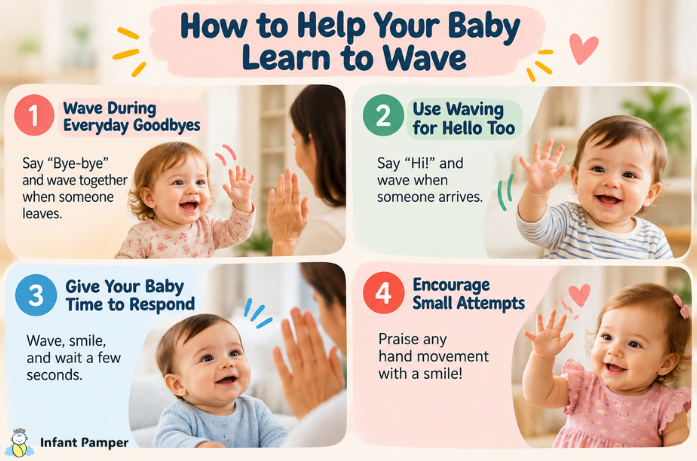
How to Help Your Baby Learn to Wave
You don’t need special toys or structured practice to teach waving. Babies usually learn best by watching the people around them and seeing the same gesture used again and again in real life.
Wave During Everyday Goodbyes
Use waving when it naturally fits into the moment. When someone leaves the house, smile, say “Bye-bye Grandma,” and wave at the same time.
Repeating this during real goodbyes helps your baby connect the hand movement with what is happening. Over time, they may begin to recognize the routine and try the gesture themselves.
Use Waving for Hello Too
Waving can also be part of greetings. When Dad comes home or a familiar person appears on a video call, try saying “Hi!” while waving.
You can even wave to your baby’s reflection in a mirror or to a favorite toy during play. These little moments make the gesture feel fun and familiar instead of something your baby is being asked to perform.
Give Your Baby Time to Respond
Babies often need a few extra seconds to understand what they have just seen.
After you wave, pause and wait instead of quickly repeating “wave, wave, wave.” Your baby may be watching your hand, thinking about the movement, and figuring out how to copy it.
Giving them that quiet moment can make the interaction feel much more relaxed.
Encourage Small Attempts
Your baby’s first try may be very small. They might lift one arm, move their fingers, or flap their whole hand.
Respond warmly when you notice these attempts. You can smile and say, “You waved bye-bye!”
Positive reactions help your baby understand that their movement had meaning, while keeping the experience playful and pressure-free.
What If My Baby Understands Bye-Bye but Doesn’t Wave?
This is very common.
Understanding words and producing gestures do not always happen at the same time.
Your baby may hear “bye-bye” and:
- look toward the door
- watch the person leaving
- smile
- become excited
- look at your waving hand
These reactions can show that your baby understands part of the situation, even if they are not waving yet.
Keep modeling the gesture naturally.
Sometimes babies spend weeks watching before suddenly copying a movement.
What About Babies Born Prematurely?
If your baby was born early, milestone timing may be considered using corrected age.
For example, a baby who arrived several weeks before their due date may reach some developmental milestones later when measured only by their birth date.
This doesn’t automatically mean anything is wrong.
If you’re unsure which age you should use when watching milestones, ask your pediatrician. They can help you understand what is appropriate for your baby’s individual development.
What If You Speak More Than One Language at Home?
You can continue speaking the languages your family naturally uses.
Your baby may hear one word for goodbye from one parent and another word from a different family member.
The gesture still gives the same visual meaning.
Using more than one language at home does not mean you need to stop using your family’s natural communication style just to help your baby wave.
What Age Do Babies Start Waving Clearly?
Many babies begin showing more purposeful waving between about 8 and 12 months. By this stage, they are often becoming better at copying movements and connecting gestures with familiar social moments.
Early waving may still look a little unsteady. Some babies move their whole arm, while others use only their fingers or wrist. These different movements can all be part of learning better coordination.
Over time, the gesture usually becomes easier to recognize and more intentional, especially when someone says hello or goodbye. The main thing to watch is steady progress rather than expecting a perfect wave right away.
Baby Not Waving Yet? Look at the Bigger Picture
One missing milestone does not tell the whole story.
Instead of focusing only on waving, think about how your baby communicates overall.
Do they:
- make eye contact?
- smile during interaction?
- respond to sounds?
- babble?
- reach toward you?
- imitate sounds or movements?
- use other gestures?
- show interest in people?
That bigger picture gives more useful information than one skill alone.
Baby Not Waving at 12 Months: Should You Worry?
If your baby is not waving by 12 months, it is a good idea to mention it at your next pediatric visit, especially if you have noticed other communication concerns too. Waving is one of several early social gestures, so your doctor will usually look at the bigger picture rather than focusing on this one skill alone.
They may ask whether your baby responds to their name, babbles, smiles during interaction, reaches to be picked up, notices sounds, or uses other gestures. These details help show how your baby is developing socially and communicating overall.
A missing wave does not automatically mean something is wrong. But sharing your concerns early can help you get reassurance, guidance, or further support if needed.
Don’t Compare Your Baby With Someone Else’s
It is so easy to compare, especially when another baby around the same age is already waving, clapping, or saying a few words. You may start wondering why your baby is not doing the same thing yet.
But babies do not learn every skill in the same order. One baby may be busy pulling to stand, another may be babbling nonstop, and another may be more interested in gestures like waving or pointing.
Milestone charts can be helpful, but they are only a guide. Try to focus on your own baby’s progress over time, and if something genuinely worries you, bring it up with your pediatrician.
Milestones such as waving, pointing, talking, and moving help parents understand how a child is developing over time. The CDC also recommends watching a child’s overall development and discussing any concerns with their healthcare provider.
FAQs About Baby Waving
Final Thoughts
Your baby’s first wave is a sweet sign that they are beginning to communicate and connect gestures with everyday moments. Some babies wave clearly, while others start with small hand movements or whole-arm flaps.
Keep talking, smiling, reading, and using simple gestures during daily routines. These natural interactions give your baby plenty of chances to watch, learn, and copy.
If you have concerns about your baby’s communication, hearing, or development, talk with your pediatrician. Every baby develops at their own pace, so focus on overall progress rather than one milestone alone.
Want more simple, reassuring baby milestone and parenting tips? Explore more helpful guides on Infant Pamper.
Disclaimer
This article is for general informational purposes only and is not a substitute for professional medical advice. If you have concerns about your baby’s development, speak with your pediatrician.
About the Author
Geeta Yogi is a parenting writer who shares practical guidance about baby milestones, early communication, infant development, and everyday parenting. Her writing focuses on helping parents understand developmental changes and support their baby’s growth through simple, natural interactions.