Written by a Caring Mom at Infant Pamper
The constant scratching of the babies is caused by their sharp nails and inability to control their movements. Babies move their hands while rubbing and bringing them closer to their faces without actually scratching themselves.
It is possible that there is a link between scratching and dry or irritated skin or even eczema. However, the soft scratching does not do any damage to babies. Nevertheless, if a baby constantly scratches one spot or there are red and irritated spots on the skin, then there is something to look into.
Table of Contents
- Baby Scratching Face: Is It Normal?
- Why Babies Scratch Their Faces
- Accidental Scratching or Itching? A Simple Way to Tell
- How to Prevent Baby Face Scratches
- How Long Do Baby Face Scratches Take to Heal?
- Signs of Infection to Watch For
- When Scratching May Be Related to Eczema
- When to Call Your Pediatrician
- FAQs About Baby Face Scratching
- Final Thoughts
Baby Scratching Face: Is It Normal?
Yes, occasional face scratching is very common in babies.
Young babies do not yet have smooth, controlled hand movements. Their arms may suddenly move toward their cheeks, forehead, nose, or eyes while they are stretching, waking, feeding, or getting tired.
Healthline also notes that newborn reflexes, including the startle reflex, can cause sudden arm movements that bring a baby’s hands toward their face.
Baby fingernails grow quickly too, and even a tiny sharp edge can leave a noticeable mark on delicate skin.
Most small surface scratches heal without a problem.
The thing to watch is whether your baby seems to be scratching accidentally or repeatedly scratching because something feels itchy.
Why Babies Scratch Their Faces
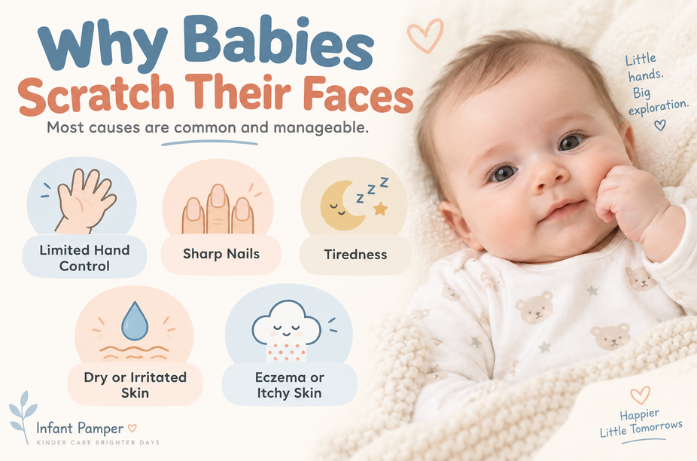
There are several common reasons babies scratch their faces, and most are harmless. The key is noticing whether the scratching looks accidental or whether your baby seems uncomfortable and keeps returning to the same area.
1. Limited Hand Control
During the first few months, babies are still learning how to control their arms and hands. Sudden movements while stretching, feeding, waking, or getting sleepy can easily bring their fingernails across their cheeks or forehead.
This type of scratching is usually accidental and becomes less common as coordination improves.
2. Sharp, Fast-Growing Nails
Baby fingernails grow quickly and can develop tiny sharp edges even when they do not look very long.
Those rough corners can leave visible scratches on delicate skin, especially during normal face-touching. Regular nail trimming or gentle filing can help reduce accidental marks.
3. Tiredness and Face Rubbing
Some babies rub or scratch their face when they are getting sleepy or overtired.
You may notice this along with yawning, eye rubbing, looking away, or becoming fussy. If the pattern mostly happens before naps or bedtime, it may simply be one of your baby’s tired cues.
Starting a calm sleep routine a little earlier may help reduce the rubbing.
4. Dry or Irritated Skin
Dry skin can feel itchy and uncomfortable, which may make your baby rub or scratch more often.
The cheeks may look rough, flaky, tight, or slightly red. Dryness can become worse after frequent baths, cold weather, dry indoor air, or fragranced skincare products.
Gentle cleansing, lukewarm water, and a baby-safe moisturizer may help. If dryness keeps coming back, ask your pediatrician for advice.
5. Eczema or Other Itchy Skin Conditions
Repeated scratching deserves more attention when the skin also looks red, rough, inflamed, or very dry.
Eczema can cause strong itching and often appears on a baby’s cheeks, forehead, scalp, or other areas. Babies may keep scratching the same spot, especially when the irritation is bothering them.
If your baby is scratching enough to break the skin, waking because of itching, or developing persistent patches, speak with your pediatrician. Treating the underlying skin irritation is usually more helpful than only trying to cover your baby’s hands.
Accidental Scratching or Itching? A Simple Way to Tell
This is one of the most useful things to notice.
Accidental scratching often happens randomly. You may see one thin scratch on otherwise healthy-looking skin, and your baby does not seem bothered.
Itching-related scratching tends to repeat. Your baby may rub the same area again and again, especially if the skin looks dry, red, rough, or inflamed.
You can think of it this way:
One random scratch + normal skin: probably accidental.
Repeated scratching + irritated skin: look for an underlying skin problem.
That simple difference can save a lot of unnecessary worry.
How to Prevent Baby Face Scratches
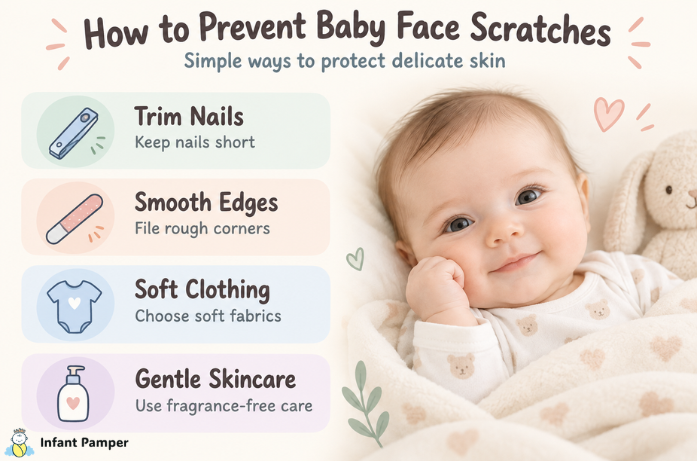
You cannot prevent every mark, but you can reduce them.
Keep Nails Short
Check your baby’s nails often.
If they feel sharp, trim or gently file them.
Many parents find it easiest to do this while their baby is asleep, feeding, or very calm.
Smooth Sharp Corners
Sometimes nail length is not the problem.
One small rough corner can cause most of the scratching.
After trimming, lightly run your finger over the edge. If it feels sharp to you, it may scratch your baby’s skin too.
Choose Soft Clothing
Soft, breathable fabrics are less likely to irritate sensitive skin.
Avoid scratchy collars or rough fabrics near the face.
Keep Skin Comfortable
If your baby’s cheeks are dry, use gentle, fragrance-free products and avoid very hot baths. For daily skin care, Johns Hopkins Medicine recommends keeping newborn skincare simple and using gentle, fragrance-free products when possible.
Little Étoile recommends gentle cleansing, careful drying, and avoiding harsh adult skin products on irritated baby skin.
If dryness does not improve, ask your pediatrician what moisturizer or treatment is suitable.
Should Babies Wear Mittens?
Baby mittens can be helpful for short periods if your newborn has sharp nails or keeps scratching irritated skin.
However, they do not need to wear mittens all day. Babies learn a lot through their hands by touching their face, bringing fingers to their mouth, and exploring different sensations.
As your baby becomes more interested in their hands, giving them safe time without mittens can support normal sensory development.
Think of mittens as a temporary helper, not the main solution. Keeping nails short and smooth, while treating any dry or itchy skin, is usually more important.
What Should You Do If Your Baby Scratches Their Face?
Most small face scratches only need gentle care.
Start by washing your hands, then clean the area with plain water and pat it dry with a soft, clean cloth. If the scratch is bleeding a little, hold clean gauze or a cloth against it with gentle pressure for a few minutes.
Avoid rubbing, scrubbing, or putting strong antiseptics on delicate baby skin. Keeping the area clean and leaving it alone is often enough for a minor scratch to heal.
What Should You Avoid Putting on a Scratch?
Parents often want to put something on the skin immediately, but more products are not always better.
Avoid using:
- Essential oils
- Adult skincare
- Strong antiseptics
- Acne products
- Fragranced creams
- Medicated products unless recommended
Do not apply a new product directly to an open scratch unless your pediatrician tells you it is safe.
Baby facial skin is sensitive, and some products can make irritation worse.
How Long Do Baby Face Scratches Take to Heal?
In most cases, minor surface scratches will start to heal after a few days since baby skin tends to heal quickly. Initially, the mark is going to appear very red but with time it will fade.
In case the scratch is kept clean, it is not likely to form a scar on the skin. It would help if you ensured that your baby does not scratch himself the same place again by ensuring his nails are smooth.
During the healing process, observe carefully for any changes in the skin around the scratch. For instance, if there is increased swelling, fever or drainage, among others, consult your pediatrician.
Signs of Infection to Watch For
Most baby scratches heal normally.
But damaged skin can occasionally become infected.
Call your pediatrician if you notice:
- Increasing redness
- Swelling
- Warmth
- Pus or drainage
- Yellow crusting
- Blisters
- Increasing tenderness
- Fever
- Your baby seeming unwell
Little Étoile also recommends medical advice if scratching repeatedly causes bleeding, skin infection, significant discomfort, or interferes with feeding or sleep.
What About Scratches Near the Eyes?
Face scratching around the eyes deserves a little more attention.
Babies often rub their eyes when tired, so occasional eye-area touching is normal.
But if your baby’s eye itself becomes red, swollen, watery, difficult to open, or seems painful after a scratch, contact your pediatrician.
An injury to the eye is different from a simple cheek scratch and should not be ignored.
A Simple 3-Step Check for Parents
If your baby keeps scratching their face, try this quick check.
1. Check the Nails
Are they long, sharp, or rough?
If yes, trim or file them.
2. Check the Skin
Does the skin look dry, red, bumpy, flaky, or inflamed?
If yes, the scratching may be caused by irritation.
3. Check the Pattern
Does scratching happen mainly before sleep?
Is it always the same area?
Does your baby seem uncomfortable?
Patterns can help you work out whether you are dealing with normal baby movement or something itchy.
When Scratching May Be Related to Eczema
Dry skin and eczema can look similar.
The difference is often how itchy and persistent the problem is.
Dry skin may look rough or flaky and may improve with gentle moisturizing.
Eczema tends to cause repeated itching, redness, inflammation, and flare-ups. A recent infant scratching study found more scratching-like hand movements in young babies with atopic dermatitis, showing that itching can begin early.
Little Étoile also distinguishes eczema from ordinary dry skin by noting that eczema is usually more persistently itchy and inflamed.
If your baby’s skin keeps flaring up or scratching affects sleep, ask your pediatrician for guidance.
Don’t Over-Wash Irritated Skin
When a baby’s face looks scratched or irritated, it can be tempting to wash it repeatedly.
But too much washing can dry the skin further.
Use lukewarm water and gentle products, and pat the skin dry rather than rubbing.
Avoid scrubbing red areas.
Simple skin care is often kinder than repeatedly trying different products.
When Scratching Happens During Sleep
Some babies rub their faces as they settle to sleep.
If the skin itself looks normal and the nails are short, this may simply be part of their sleepy movements.
Try noticing whether your baby also yawns, turns away, becomes quieter, or starts fussing.
If so, scratching may be one of their tired cues.
Starting the bedtime or nap routine slightly earlier may reduce some of the rubbing.
When to Call Your Pediatrician
Speak with your baby’s healthcare provider if:
- Scratching is constant or intense
- Your baby seems very itchy
- There is a persistent rash
- The skin becomes raw or repeatedly bleeds
- Scratches keep reopening
- There is swelling, pus, or crusting
- Your baby develops a fever
- Scratching affects sleep or feeding
- You are worried about an eye injury
You should also ask for advice if gentle skincare is not improving dry or irritated skin.
The goal is not simply to stop the hands.
It is to understand why your baby wants to scratch in the first place.
FAQs About Baby Face Scratching
Final Thoughts
Seeing your baby scratching face can be worrying, but in many cases it happens because of sharp nails, limited hand control, or simple tiredness. As your baby grows and coordination improves, these accidental scratches usually become less frequent.
The best approach is to keep nails short and smooth, use gentle skincare, and watch for patterns. If the skin looks dry, red, rough, or your baby keeps scratching the same area, there may be irritation or eczema that needs attention.
Most small scratches heal quickly with basic care. But if you notice swelling, pus, spreading redness, repeated bleeding, or scratching that is affecting sleep or comfort, contact your pediatrician for advice.
Tiny face scratches are common, but a little nail care and gentle skin care can make a big difference. Explore more simple, reassuring baby-care tips from Infant Pamper.
Disclaimer
This article is for general informational purposes only and is not a substitute for medical advice. Always speak with your pediatrician or healthcare provider if your baby has persistent itching, a rash, signs of infection, or any skin problem that worries you.
About the Author
Geeta Yogi is a parenting writer who shares gentle, practical guidance about newborn care, baby skin, everyday infant behavior, and common parenting concerns. Her writing focuses on helping parents understand normal baby habits, care for sensitive skin, and recognize when persistent scratching or irritation may need professional medical attention.