Written by a Caring Mom at Infant Pamper
When can babies sit in a high chair? Most babies are ready at around 6 months old, when they have developed enough head, neck, and upper-body control to stay upright safely with support. The exact timing can vary, so it is better to watch your baby’s posture and stability than focus only on age. A baby who can hold their head steady, sit without constantly slumping, and remain comfortable for a short period is usually getting close to being ready.
Using a high chair is also closely connected with the start of solid foods, which makes this an important milestone for many families. That first time your baby sits at the table can feel exciting, but there is no need to rush it. In this guide, we’ll cover the main readiness signs, the safest way to introduce a high chair, common mistakes to avoid, and simple tips to help make early mealtimes more comfortable.
Table of Contents
- When Can Babies Sit in a High Chair?
- Signs Your Baby Is Ready
- A Simple High Chair Readiness Check
- High Chair Readiness and Starting Solids
- How Should a Baby Sit in a High Chair?
- High Chair Safety Tips
- Choosing a High Chair
- When Should Babies Stop Using a High Chair?
- Frequently Asked Questions
- Final Thoughts
When Can Babies Sit in a High Chair?
Most babies begin using an upright high chair at about 6 months.
Some may be ready slightly earlier, while others need a few more weeks. Instead of watching the calendar too closely, look at how your baby controls their head, neck, and body.
Your baby may be ready if they can:
- Hold their head upright and steady
- Sit with a little support
- Keep their chest upright
- Avoid constantly falling to one side
- Stay comfortable for several minutes
Your baby does not always need to sit completely independently before using a supportive high chair.
Signs Your Baby Is Ready
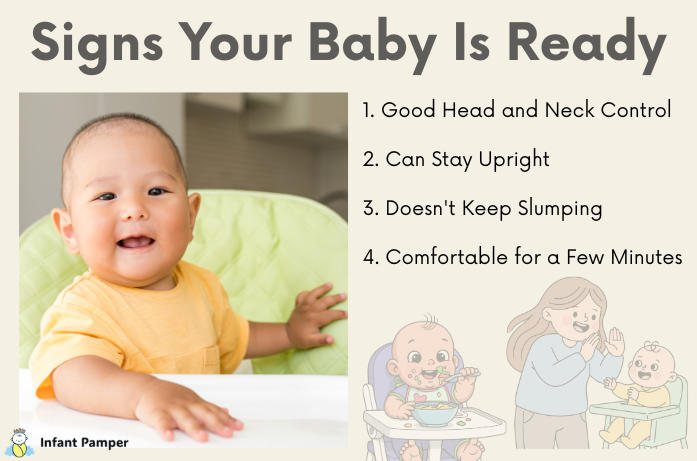
1. Good Head and Neck Control
Your baby’s head should stay reasonably steady when sitting upright.
A little wobbling is normal, but their head should not repeatedly fall forward, backward, or to one side.
2. Can Stay Upright
Your baby’s chest should remain upright rather than constantly folding forward.
If you need to hold their body in position the whole time, they may need a little more time before regular high-chair use.
3. Doesn’t Keep Slumping
Occasional leaning is normal while babies are learning to sit.
But repeated sliding, falling sideways, or collapsing forward can mean your baby is not quite ready yet.
4. Comfortable for a Few Minutes
Some babies sit well at first and then become tired quickly.
Start with short sessions. Five or ten comfortable minutes can be enough in the beginning.
A Simple High Chair Readiness Check
Place your baby in the chair when they are awake and calm.
Watch them for a few minutes and ask yourself:
- Is their head staying upright?
- Is their chest lifted?
- Can they turn their head comfortably?
- Are they constantly sliding down?
- Do they seem relaxed?
If your baby looks stable and comfortable, they may be ready for short high-chair sessions.
If not, wait a little longer and try again another week.
When Do Babies Start Using High Chairs?
Many babies begin around the same time they start exploring solid foods.
You may notice your baby watching your plate, following your spoon, or reaching toward food.
That interest is adorable, but curiosity alone does not mean your baby is ready.
They also need enough physical control to sit safely and comfortably.
High Chair Readiness and Starting Solids
High-chair readiness and solid-food readiness often happen around the same time, but they are not exactly the same.
A baby may enjoy sitting with the family before they are ready to eat much.
Before starting complementary foods, your baby should also show developmental readiness, including steady head control and the ability to sit upright with support.
The Centers for Disease Control and Prevention (CDC) notes that foods other than breast milk or infant formula are generally introduced at around 6 months of age, making this an important stage for both feeding and sitting development.
There is no rule saying your baby’s first time in the chair must also be their first meal. As your baby becomes comfortable with solids, simple foods such as prune puree for baby can add more variety to early mealtimes.
You can simply let them sit for a few minutes and get used to their new seat.
When to Start Using High Chair for Meals
Once your baby can sit comfortably, begin slowly.
Place them in the chair during a family meal for a few minutes. Sit nearby, talk to them, and let them watch what everyone else is doing.
Short, relaxed sessions can help your baby become familiar with the chair without making mealtime stressful.
When your baby is ready to begin eating, a soft broccoli puree for baby can be one simple food to introduce alongside other age-appropriate options.
How Should a Baby Sit in a High Chair?
Your baby’s head should be upright, their chest should remain lifted, and their bottom should sit securely toward the back of the chair.
Always fasten the safety harness according to the manufacturer’s instructions.
Do not rely on the tray to keep your baby secure.
If your baby needs lots of cushions or rolled towels just to remain upright, check whether the chair fits correctly and whether your baby is really ready.
Does Foot Support Matter?
If your high chair includes an adjustable footrest, proper foot support may help your baby feel more stable and comfortable.
Think about eating while your own feet are hanging in the air. It can feel awkward.
Adjust the footrest according to the manufacturer’s instructions so your baby has appropriate support while sitting.
What If My Baby Slumps?
First, check the seat and harness adjustments.
If your baby still repeatedly folds forward, slides down, or leans heavily to one side, they may simply need more time to build sitting strength.
Take them out and try again later rather than forcing a long session.
Supervised floor play and tummy time naturally help babies strengthen the muscles used for sitting.
What Is the Typical High Chair Age?
Around six months is a common starting point, but every baby is different.
Always check the manufacturer’s age, weight, and developmental recommendations for your specific chair.
Some high chairs include a reclining setting for younger babies. That does not mean a young infant is ready for upright feeding or solid foods.
A reclined infant position and an upright feeding position are different.
High Chair Safety Tips
Once babies get stronger, they can twist, push, reach, and try to stand surprisingly quickly.
A few simple safety habits matter:
- Always use the safety harness.
- Never depend on the tray as a restraint.
- Keep the chair away from walls, tables, and counters.
- Never leave your baby unattended.
- Check that folding chairs are completely locked before use.
- Keep hot drinks and sharp objects out of reach.
- Never allow your baby to stand in the chair.
The American Academy of Pediatrics also recommends using the safety straps every time, keeping high chairs away from tables or counters, making sure folding chairs are locked, and never leaving a young child alone in the chair.
Check the High Chair Regularly
Your baby’s chair also needs an occasional safety check.
Look at the:
- Harness straps
- Buckles
- Screws
- Tray locks
- Folding mechanisms
- Wheels or brakes
- Plastic parts
If something feels loose, cracked, or damaged, stop using the chair until it has been properly checked or repaired.
Using a Second hand High Chair
A secondhand high chair can save money, but inspect it carefully first.
Check the brand and model number, make sure the original straps and hardware are present, and look for any product recalls.
Avoid using homemade straps or replacing important safety parts with pieces that were not designed for the chair.
An older chair can look perfectly fine while still missing an important safety feature.
Choosing a High Chair
You don’t need the most expensive chair.
Look for one that is stable, secure, easy to clean, and suitable for your baby’s size.
Helpful features include:
- A sturdy base
- Secure safety straps
- Easy-to-clean surfaces
- A locking tray
- An adjustable footrest
- A design that fits your home
And yes, easy cleaning really matters.
Once solids begin, food somehow reaches places you didn’t even know your high chair had.
A Simple First High-Chair Routine
Your baby’s first session can be very short.
Place them in the chair, fasten the harness, sit nearby, and let them explore the tray.
You might offer a baby-safe spoon or cup if appropriate.
After five or ten minutes, take them out while they are still comfortable.
A short, happy first experience is better than keeping a tired baby in the chair for too long.
How Long Can Babies Stay in a High Chair?
There is no perfect time limit for every baby.
Watch your baby’s posture and mood.
If they are sitting comfortably and enjoying mealtime, that’s a good sign.
If they start slumping, crying, rubbing their eyes, or repeatedly trying to escape, they may be tired and ready to come out.
A high chair is mainly for meals and family-table time. Babies still need plenty of free movement and floor play throughout the day.
When Should Babies Stop Using a High Chair?
Most children stop using a high chair somewhere between 18 months and 3 years old, although the right time depends more on your child’s size, behavior, and sitting skills than age alone.
Your toddler may be ready to move to a booster seat when they are getting too big for the high chair, frequently trying to climb out, have reached the manufacturer’s height or weight limit, or can sit safely and steadily at the family table.
Always follow the instructions for your specific high chair, and choose the next seating option based on your child’s safety and development rather than rushing the transition.
Frequently Asked Questions
Final Thoughts
If you’re wondering when can babies sit in a high chair, around six months is a common starting point, but readiness is more important than age alone. Your baby should be able to hold their head and neck steady, stay reasonably upright with support, and sit comfortably without repeatedly slumping or sliding down in the seat.
Every baby develops at a slightly different pace, so there is no need to rush this milestone. Start with short high-chair sessions, always secure the safety harness, follow your chair manufacturer’s guidelines, and give your baby time to build confidence before longer meals. A calm, well-supported sitting position can make early feeding safer, easier, and more enjoyable for both you and your baby.
For more simple, parent-friendly guides on baby feeding, development, sleep, and everyday care, explore more helpful articles on Infant Pamper and feel a little more confident through each new stage.
Disclaimer
This article is for general informational purposes only and is not a substitute for professional medical advice. Every baby develops differently, so if you have concerns about your baby’s sitting ability, feeding readiness, growth, or development, speak with your pediatrician or another qualified healthcare professional.
About the Author
Geeta Yogi is a parenting writer who shares practical guidance about baby feeding, developmental milestones, mealtime safety, and everyday infant care. Her writing focuses on helping parents recognize readiness signs, introduce new routines safely, and feel more confident as their babies grow through each new stage.