
Written by a caring mom at Infant Pamper
Being a new parent is often like playing a guessing game. While your baby may seem very content one minute, the next moment you may see them fussing, turning their face away, or crying. Some common sleepy cues include yawning, droopy eyelids, staring off into space, and quiet or fussy behavior.
Recognizing what your newborn displays when they are sleepy can make it easier for you to catch tiredness before your baby gets overtired. Because babies cannot let us know if they are sleepy, they tell us through subtle changes in their body and actions.
You won’t recognize all of the sleepy cues right away, but that’s okay! Over time, you’ll start to recognize the patterns that your baby has when they are tired.
Table of Contents
- Sleepy Cues Newborn Parents Can Watch For
- Early Sleep Cues vs Overtired Signs
- Your Baby Moves Through Different States Before Sleep
- Sleepy or Hungry? Look at the Whole Picture
- How to Respond When Your Newborn Looks Sleepy
- Should You Use Wake Windows for a Newborn?
- Safe Sleep Matters More Than Any Sleep Trick
- Frequently Asked Questions
- Final Thoughts
- Disclaimer

Sleepy Cues Newborn Parents Can Watch For
A sleepy newborn doesn’t always yawn dramatically and close their eyes.
Some signs are surprisingly subtle.
Your baby might stop looking at you, stare into the distance, slow their movements, or suddenly seem less interested in what is happening around them.
Common tired signs can include:
- yawning
- fluttering or droopy eyelids
- staring into space
- looking away from your face
- difficulty focusing
- becoming quieter
- sucking fingers
- closing their fists
- jerky arm or leg movements
- pulling at their ears
- mild fussiness
- arching their back
Your baby may show several of these or only one.
The important thing isn’t memorizing every possible sign. It’s beginning to recognize the signals your own baby repeats.
Early Sleep Cues vs Overtired Signs
One of the most useful things I learned as a mom is that tiredness often comes in stages.
Early tired signs can be quiet and easy to miss.
Your baby might:
- become less interested in your face
- move less
- stare past you
- blink slowly
- develop heavy eyelids
- become unusually quiet
These early newborn sleepy cues are often a good time to reduce stimulation and begin winding down.
If your baby stays awake longer, the signs may become louder.
An overtired or overstimulated baby might cry, kick, arch away from you, wave their arms, or seem unable to settle even though they are clearly exhausted.
Cleveland Clinic also notes that signs of tiredness can include yawning, looking away, rubbing the eyes, pulling at the ears, sucking fingers and becoming fussy.
Missing the early stage doesn’t mean you’ve done anything wrong. Sometimes those little cues last only a moment.
Your Baby Moves Through Different States Before Sleep
Here’s something that can make newborn behavior much easier to understand.
Newborns naturally move through different states of sleep and alertness throughout the day.
According to the American Academy of Pediatrics describes six newborn states: deep sleep, light sleep, drowsiness, quiet alertness, active alertness, and crying.
During the drowsy state, your baby’s eyelids may begin to close, their eyes may roll slightly, and they might stretch, yawn, or make little jerky movements.
By comparison, during the quiet-alert state, your baby may have wide-open eyes and calmly focus on your face or voice.
Learning to notice that transition from alert to drowsy can be more helpful than waiting until your baby starts crying.
Why Does Catching Tired Signs Early Help?
Noticing your baby’s early tired signs can make settling for sleep a little easier. A calm, sleepy newborn may be more ready to rest than a baby who has already become fussy, overstimulated, or very tired.
When you notice signs such as yawning, looking away, or becoming quieter, start slowing things down. Dim the lights, reduce noise and play, check the diaper, offer a feed if needed, and move into a calm sleep routine.
Overtired babies can sometimes be harder to settle, so think of sleepy cues as gentle signals to reduce stimulation not a strict deadline your baby has to follow.
Sleepy or Hungry? Look at the Whole Picture
Tiredness and hunger can look very similar in a newborn, which is why this part often feels confusing for parents. Hand-sucking, crying, and fussiness may happen when a baby is sleepy, hungry, uncomfortable, or simply looking for comfort.
According to CDC guidance on hunger cues, babies from birth to 5 months may show hunger by bringing their hands to their mouth, turning toward the breast or bottle, smacking or licking their lips, and keeping their hands clenched. Crying is usually a later hunger sign.
Instead of focusing on one cue, look at the full picture. Think about when your baby last fed and whether they are rooting or actively searching for milk. If they recently had a good feed and are now looking away, blinking slowly, becoming quieter, or losing interest in interaction, they may simply be ready for sleep.
And if you are still unsure, offering a feed is completely okay. With time, your baby’s little patterns will become easier to recognize.
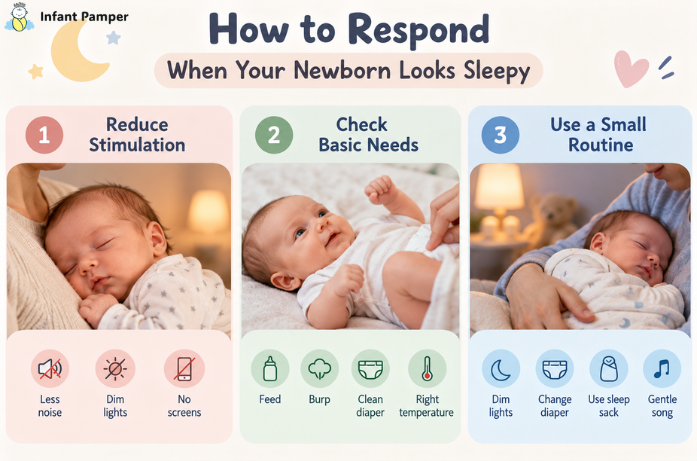
How to Respond When Your Newborn Looks Sleepy
Once you notice your baby winding down, keep your response simple.
You don’t need an elaborate nap routine for a newborn.
1. Reduce Stimulation
Move away from loud conversation, screens, bright lights, and energetic play.
Speak softly and hold your baby calmly.
A quiet environment gives their developing nervous system fewer things to process.
2. Check Basic Needs
Before settling, quickly check whether your baby might need:
- a feed
- burping
- a fresh diaper
- a more comfortable temperature
- some cuddling
Sometimes what looks like sleep resistance is really a wet diaper or trapped wind.
3. Use a Small, Familiar Routine
A tiny routine repeated before sleep can become a gentle cue of its own.
You might dim the lights, change the diaper, use a sleep sack, cuddle for a few minutes, and hum the same quiet song.
It doesn’t need to be complicated or perfectly timed.
Should You Use Wake Windows for a Newborn?
Wake windows can be helpful as a general guide, but newborn sleep is still developing and can vary a lot from day to day.
According to MedlinePlus, newborns under 2 months may sleep around 14–17 hours in 24 hours and often stay awake for only short periods between sleep. Some babies become tired quite quickly, while others may stay content and alert a little longer.
Instead of watching the clock too closely, use wake windows together with your baby’s behavior. If your baby starts yawning, looking away, becoming quieter, or losing interest, they may be ready to rest even if the expected wake time is not over yet.
What If My Newborn Doesn’t Show Obvious Sleep Signs?
Not every newborn gives clear sleepy signals. Some babies yawn or become fussy, while others seem calm and then suddenly start crying.
If your baby’s cues are hard to notice, watch what usually happens just before sleep. Their eyes may look less focused, their body may relax, they may turn away from you, or their sucking may slow during a feed.
These small patterns can become easier to spot over time. You can also make a quick note of what happens before naps for a few days to help you recognize your baby’s own tired signs.
Safe Sleep Matters More Than Any Sleep Trick
Recognizing tiredness is helpful. But once your baby is ready to sleep, safety comes first.
The CDC’s safe sleep guidance recommends putting babies on their backs for every nap and nighttime sleep on a firm, flat sleep surface such as an approved crib or bassinet with a fitted sheet.
Keep pillows, loose blankets, bumper pads, stuffed animals, and other soft bedding out of the sleep space.
CDC also recommends keeping your baby’s sleep space in the same room where you sleep, ideally for at least the first 6 months.
No sleep routine, product, positioner, or trick is more important than a safe sleep setup.
What If Your Baby Seems Sleepy All the Time?
Newborns naturally sleep a lot, especially during the first few weeks. Much of the day may feel like a repeating cycle of feeding, changing, cuddling, and sleeping.
MedlinePlus explains that newborn sleep-wake patterns are still developing, so frequent sleep is normal. But there is a difference between a baby who sleeps often and one who is unusually hard to wake or is not feeding well.
Call your pediatrician if your baby seems much sleepier than usual, is difficult to wake for feeds, has trouble feeding, seems weak, has breathing problems, or simply seems different from their normal self. If something feels off, it is always okay to ask.
Don’t Turn Sleep Cues Into Another Parenting Test
Newborn sleep can already feel overwhelming, so try not to turn every yawn or missed nap into something you have to get exactly right. You do not need to catch every sleepy cue or know the perfect moment your baby should fall asleep.
Learning your baby’s signals takes time. Some days you will understand exactly what they need, and other days you may feed, burp, change, cuddle, and rock them before figuring it out.
That does not mean you are doing anything wrong. It is simply part of getting to know your newborn, one small moment at a time.
Frequently Asked Questions
Final Thoughts
Learning your baby’s sleep signals can make those early newborn days feel a little less confusing. The sleepy cues newborn babies show are often small droopy eyelids, looking away, staring quietly, slowing down, or beginning to fuss.
You don’t have to recognize every sign perfectly. Pay attention to patterns, respond gently, and remember that your baby’s cues will become more familiar as the weeks pass.
Most importantly, keep sleep safe and try not to let schedules or “perfect sleep” advice steal your confidence. You and your baby are learning each other one sleepy little moment at a time.
At Infant Pamper, we believe newborn care should feel supportive and practical, not like another test you have to pass.
Disclaimer
This article is for informational purposes only and is not a substitute for medical advice. If you have concerns about your newborn’s sleep, feeding, or unusual behavior, speak with your pediatrician.
About the Author
Geeta Yogi is a parenting writer who shares practical guidance about newborn sleep, baby cues, feeding, infant development, and everyday newborn care. Her writing focuses on helping new parents understand their baby’s changing signals and feel more confident during the early weeks and months.