
Written by a Caring Mom at Infant Pamper
Having your baby sleeping with their mouth agape is mostly due to their congested nasal passage, which is common in times of catching a cold. In some instances, the baby’s lips might relax whilst sleeping without necessarily signifying any breathing issues. As long as the baby is breathing well, eating normally, maintaining the usual skin color, and is comfortable, breathing through the mouth may not be a cause of concern.
The main issue is how many times the baby breathes through the mouth. If the baby sleeps with their mouth open along with snoring loudly, gasping from time to time, having trouble eating or breathing, this should be brought to a pediatrician’s attention.
Table of Contents
- Baby Sleeping With Mouth Open: Quick Answer for Parents
- Why Does a Baby Sleep With Their Mouth Open?
- What Can You Do if Your Baby Is Congested?
- Normal-Looking vs. More Concerning Signs
- When Breathing Trouble Is an Emergency
- A Simple 3-Step Check for Parents
- Safe Sleep Still Comes First
- FAQs About Baby Mouth Breathing During Sleep
- Final Thoughts
- Disclaimer
Baby Sleeping With Mouth Open: Quick Answer for Parents
Seeing your baby’s little mouth open during sleep can make you immediately wonder if something is wrong.
Here is the simple way to look at it:
Occasional open mouth + peaceful breathing: usually something you can observe.
Open mouth + stuffy nose: congestion may be making nasal breathing harder.
Open mouth every night + snoring or noisy breathing: worth discussing with your pediatrician.
Open mouth + struggling to breathe, blue or gray lips, or repeated gasping: get urgent medical help.
Young babies normally rely heavily on nasal breathing, especially during feeding. Temporary nasal blockage is therefore one common reason they may start using their mouth more.
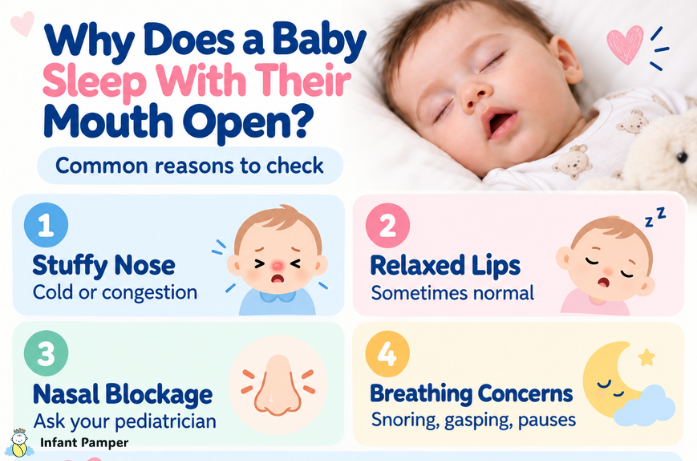
Why Does a Baby Sleep With Their Mouth Open?
There are a few possible reasons, and many of them are simple. The most common is nasal congestion, but frequent mouth breathing can sometimes mean your baby is having trouble getting enough airflow through the nose.
1. A Stuffy Nose
A cold or blocked nose can make nasal breathing harder. Because babies have very small nasal passages, even a little mucus can make them sound congested.
You may notice snuffling, visible mucus, restless sleep, or more pauses during feeding. If the open-mouth sleeping started at the same time as a runny or stuffy nose, congestion may be the reason.
2. Relaxed Lips During Sleep
Sometimes a baby’s lips simply fall open while they are sleeping, especially during a deep nap.
If your baby is breathing quietly, looks comfortable, and closes their mouth normally while awake, occasional open-mouth sleeping may not be a concern. One nap with parted lips is different from mouth breathing during most sleeps.
3. Ongoing Nasal Blockage
If your baby regularly sleeps with their mouth open even when they are not sick, mention it to your pediatrician.
Persistent mouth breathing can sometimes happen when something is limiting airflow through the nose or upper airway. The Cleveland Clinic explains that frequent mouth breathing can happen when nasal airflow is limited by problems such as congestion or enlarged adenoids. If your baby regularly breathes through their mouth, a pediatrician can check the nose and airway for a possible cause.
4. Sleep-Related Breathing Problems
Mouth breathing alone does not mean your baby has sleep apnea. A review on PubMed Central explains that babies mainly rely on nasal breathing, and symptoms like snoring, breathing pauses, or restless sleep may need medical evaluation.
It becomes more concerning when it happens with loud snoring, gasping, choking sounds, pauses in breathing, or very restless sleep.
If you notice these signs regularly, it is best to speak with your pediatrician rather than assuming the open mouth is simply a sleep habit.
Is Your Baby Actually Mouth Breathing?
An open mouth does not always mean your baby is truly breathing through it.
When you notice your baby sleeping with their mouth open, watch quietly for a moment. Check whether they seem to be breathing comfortably through the nose, whether their chest is moving normally, and whether there is any snoring, harsh breathing, or unusual color change.
Also notice what happens while your baby is awake and feeding. If they feed well, breathe normally during the day, and only occasionally sleep with relaxed lips, it is usually less concerning than regular mouth breathing during most sleeps.
Feeding Can Give You Another Clue
Babies need to coordinate sucking, swallowing, and breathing during feeds.
That is why a blocked nose can make feeding surprisingly difficult.
A congested baby may repeatedly pull away from the breast or bottle to breathe, become frustrated, or take longer than usual to finish a feed.
Young babies rely strongly on nasal breathing while feeding, which is one reason persistent nasal blockage deserves attention.
If your baby’s open-mouth sleeping comes with a sudden change in feeding, mention both symptoms when speaking with your pediatrician.
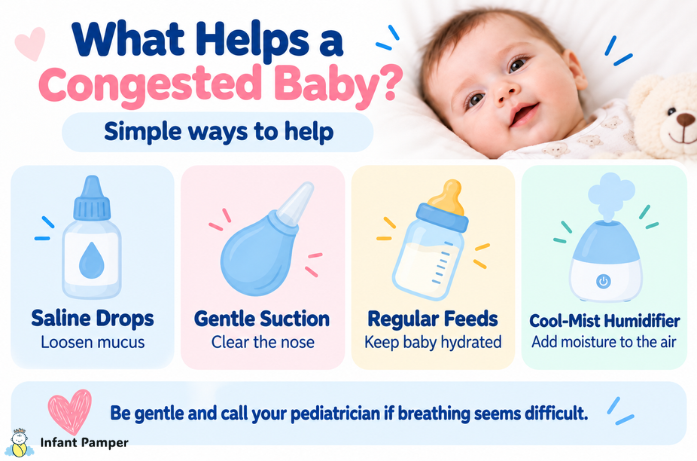
What Can You Do if Your Baby Is Congested?
If your baby’s breathing looks comfortable and congestion appears mild, a few gentle steps may help clear the nose.
Use Plain Saline
Plain saline drops can help loosen dried or sticky mucus.
A few drops before feeding or sleep may make mucus easier to remove.
Try Gentle Nasal Suction
After saline loosens the mucus, you can gently use a bulb syringe or baby nasal aspirator if needed.
You do not need to suction constantly.
Too much suction can irritate the delicate inside of your baby’s nose.
Offer Regular Feeds
Keeping your baby well hydrated can help keep mucus thinner.
For young babies, continue offering breast milk or formula as appropriate.
The AAP recommends saline, gentle suction, and good hydration as practical ways to help a congested baby breathe more comfortably.
Consider a Cool-Mist Humidifier
A clean cool-mist humidifier may make a dry room feel more comfortable when your baby’s nose is irritated or stuffy.
Follow the manufacturer’s cleaning instructions carefully because humidifiers that are not cleaned properly can grow mold or bacteria.
Huckleberry also recommends adding moisture to the air as one way to ease short-term congestion.
What You Should Not Do
When your baby sounds congested, it is tempting to try anything that looks like it might help them breathe.
But some common ideas are unsafe.
Do Not Raise the Mattress
Do not place towels, pillows, wedges, or other objects under the mattress to lift your baby’s head.
The AAP advises babies to sleep on a firm, flat, non-inclined surface, even when they have a stuffy nose.
Do Not Add Pillows or Positioners
Your baby’s crib or bassinet should stay clear of pillows, loose blankets, stuffed toys, and sleep positioners.
CDC safe-sleep guidance also recommends placing babies on their backs for every sleep on a firm, flat surface.
Do Not Try to Hold Their Mouth Closed
Never tape, strap, or physically force your baby’s mouth shut during sleep.
If your baby is opening their mouth because their nose is blocked, closing the mouth does not fix the reason.
Watch the breathing and address the underlying congestion instead.
When Is an Open Mouth More Worth Watching?
Think about pattern + symptoms, rather than the mouth alone.
You may want to contact your pediatrician if:
- It happens during most naps and nighttime sleep
- Your baby regularly snores loudly
- Mouth breathing continues after a cold has cleared
- Your baby often sounds congested without being sick
- Feeding has become more difficult
- Sleep seems unusually restless
- You hear choking or gasping
- You notice breathing pauses
A short video of the breathing pattern can sometimes be useful to show your pediatrician, as long as your baby is comfortable and you are not delaying urgent care.
Normal-Looking vs. More Concerning Signs
Here is an easy way to separate the two.
| Usually Less Concerning | Talk to a Doctor |
| Mouth occasionally falls open | Mouth open during most sleeps |
| Mild temporary cold | Persistent nasal blockage |
| Quiet, comfortable breathing | Regular loud snoring |
| Normal feeding | Trouble feeding |
| Normal skin color | Pale, blue, or gray color |
| Baby seems settled | Gasping, choking, or struggling |
This is not a diagnostic chart.
It is simply a practical way to decide whether you are seeing an occasional sleep quirk or a breathing pattern worth discussing.
Can Long-Term Mouth Breathing Matter?
Persistent mouth breathing is different from occasionally sleeping with relaxed lips during a cold. The Sleep Foundation explains that occasional mouth breathing during a cold is different from persistent mouth breathing, which may be linked with snoring or disturbed sleep.
When mouth breathing continues over time in children, it can be associated with poorer-quality sleep, snoring, dry mouth, dental changes, and other airway-related problems.
But try not to jump from one open-mouth nap to worrying about long-term complications.
The important word here is persistent.
If the pattern keeps happening when your baby is otherwise healthy, asking your pediatrician is much more useful than trying to diagnose the cause online.
When Breathing Trouble Is an Emergency
An open mouth alone usually does not mean there is an emergency.
Struggling to breathe does.
Seek urgent medical help if your baby:
- Is working hard for every breath
- Has blue or gray lips or face
- Can barely cry or make sounds because breathing is difficult
- Has severe or repeated gasping
- Appears unusually weak or unresponsive
- Cannot feed because they cannot breathe comfortably
The AAP specifically advises emergency care when a baby is struggling for each breath, can barely make sounds or cry, or develops bluish lips or facial color.
When breathing looks seriously wrong, do not spend time trying home remedies first.
A Simple 3-Step Check for Parents
When you see your baby’s mouth open during sleep, you can remember three things:
1. Look
Does your baby look comfortable? Is their color normal?
2. Listen
Is breathing quiet, or are you hearing loud snoring, choking, or gasping?
3. Notice the Pattern
Is this happening only during a cold, or almost every night?
That little check can help you respond calmly without ignoring something that deserves attention.
Safe Sleep Still Comes First
Whether your baby has a stuffy nose or sleeps with their mouth slightly open, safe-sleep recommendations stay the same.
Put your baby on their back for every sleep.
Use a firm, flat sleep surface such as an approved crib or bassinet mattress with only a fitted sheet.
Keep pillows, loose blankets, stuffed animals, wedges, and sleep positioners out of the sleep area.
Comfort your congested baby while they are awake, clear their nose gently when needed, and then return them to a safe sleep space.
FAQs About Baby Mouth Breathing During Sleep
Final Thoughts
Seeing your baby sleeping with mouth open can feel worrying, but an occasional open mouth is often less concerning when your baby is breathing comfortably, feeding well, and sleeping peacefully.
If mouth breathing happens often, continues after congestion clears, or comes with snoring, gasping, feeding trouble, or breathing difficulty, speak with your pediatrician. Focus on the overall breathing pattern, not just the position of your baby’s lips.
Every baby is different. Keep watching your little one’s breathing patterns, and explore more gentle baby sleep and care tips from Infant Pamper.
Disclaimer
This article is for general informational purposes only and is not a substitute for professional medical advice. If you have concerns about your baby’s breathing, sleep, feeding, or health, contact your pediatrician or healthcare provider.
About the Author
Geeta Yogi is a parenting writer who shares practical, reassuring guidance about baby sleep, breathing, newborn care, and everyday infant health concerns. Her writing focuses on helping parents understand common baby behaviors, recognize signs that may need medical attention, and create safer, more comfortable routines for their little ones.