Written by a Caring Mom at Infant Pamper
If you are wondering what should a 5-year-old know, you may be thinking about reading, counting, writing their name, or getting ready for kindergarten. But at five, development is about much more than academics.
Your child is also learning how to communicate clearly, manage emotions, follow directions, play with others, take care of simple tasks, and become more independent.
Some five-year-olds read simple words, while others are still learning letter sounds. Some are very social but need help with writing. Every child develops at a slightly different pace, so it is better to look at overall progress instead of expecting every skill at once.
Table of Contents
- What Should a 5 Year Old Know?
- Language and Communication Skills
- Early Reading Skills
- Social Skills at Age 5
- Independence Skills
- School Readiness Is More Than ABCs
- Easy Ways to Help Your 5-Year-Old Learn at Home
- When Should You Speak to Your Pediatrician?
- FAQs About 5-Year-Old Development
- Final Thoughts
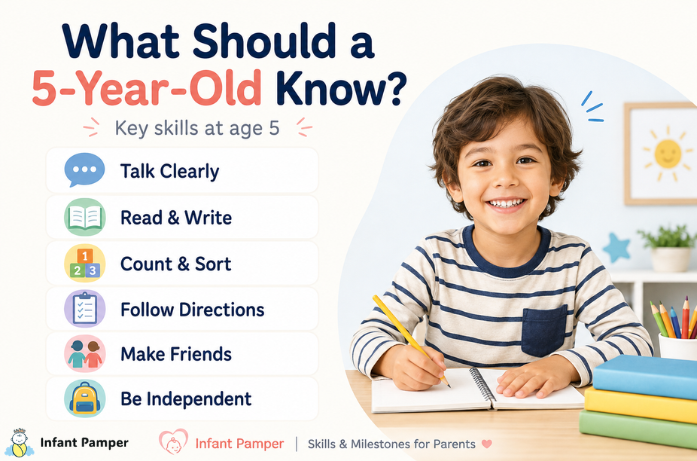
What Should a 5-Year-Old Know?
By age five, many children become more curious, confident, talkative, and independent.
You may notice more questions, longer stories, stronger opinions, and plenty of “I can do it myself.”
At this age, parents can look at development in a few main areas:
- Language and communication
- Reading and writing
- Basic math
- Thinking and memory
- Social and emotional skills
- Physical development
- Independence
- Safety awareness
- School readiness
Your child does not need to be perfect in every area.
The main thing is that they are learning new skills over time. The CDC’s 5-year developmental milestones also look at development across social and emotional skills, communication, learning and thinking, and physical movement. These milestones are useful guides for noticing your child’s progress, rather than a test every child must complete at exactly the same time.
1. Language and Communication Skills
Most five-year-olds can speak in clear sentences, explain what happened during the day, ask lots of questions, and follow simple multi-step directions.
They may also retell parts of a story, describe people or places, and use more detailed words. Imaginative storytelling is common too, and it helps build both language and creativity.
2. How to Support Language at Home
You do not need special lessons. Everyday conversation is one of the best ways to build language.
Ask open questions such as, “What made you happy today?” or “What do you think will happen next?” Reading aloud every day also supports vocabulary, listening, and comprehension.
3. Early Reading Skills
Not every five-year-old needs to read independently. Many are still learning the basic skills that come before fluent reading.
Your child may recognize letters, know some letter sounds, identify their own name, enjoy rhyming words, remember familiar stories, or begin sounding out simple words.
Keep books enjoyable. Let your child choose stories, talk about the pictures, and guess what might happen next.
4. Writing and Fine Motor Skills
At five, hand control is usually improving. Your child may attempt to write their name, copy simple shapes, draw more detailed pictures, use scissors, complete puzzles, or manage some buttons and zippers.
Handwriting may still look messy, and that is very normal.
Helpful fine-motor activities include:
- Playdough and coloring
- Building blocks and puzzles
- Cutting paper, stickers, and chalk
These playful activities strengthen the small muscles used for writing.
5. Basic Math Skills
Math at five should still feel practical and fun. Many children are learning to count objects, recognize numbers, compare more and less, identify shapes, sort items, and notice simple patterns.
You can build these skills during normal routines. Count steps, divide snacks, compare toy towers, or ask which object is bigger or smaller.
These small moments make early math easier to understand.
6. Thinking, Memory, and Problem-Solving
Five-year-olds are also becoming better at remembering routines, following steps in order, explaining why something happened, and solving small problems.
You can encourage these skills with simple questions like, “What should we do first?” or “How can we fix this?”
That helps your child think independently without making learning feel like homework.
7. Social Skills at Age 5
Social skills become especially important as children spend more time with classmates and friends.
Many five-year-olds are learning to take turns, follow game rules, join group play, share more often, understand other people’s feelings, and solve small disagreements with help.
Do not expect perfect behavior. Social skills take practice, and children may handle a situation well one day and struggle the next.
8. Emotional Skills
Five-year-olds can often name feelings such as anger, sadness, or fear, but managing those feelings is still difficult.
Your child may be learning to explain why they are upset, wait briefly, recover from disappointment, ask for help, and use words instead of hitting or grabbing.
When feelings get big, try naming the emotion. Saying, “You look disappointed because the game ended,” can help your child understand what they are feeling. According to Nemours KidsHealth, five-year-olds are becoming more independent and forming stronger friendships, but big emotions and occasional meltdowns can still happen. This is one reason patience and simple emotional support are still so important at this age.
9. Independence Skills
Many five-year-olds want to do more by themselves. This is a good time to let them practice everyday tasks.
They may be able to dress with little help, put on shoes, use the toilet independently, wash their hands, feed themselves, put toys away, and help with simple household jobs.
Do not correct every small mistake. A backwards shirt or mismatched socks are still part of learning independence.
10. Physical Skills
Most five-year-olds enjoy running, jumping, climbing, dancing, and playing with balls.
Common physical skills at this age include:
- Running, jumping, and hopping on one foot
- Throwing, catching, and kicking a ball
- Balancing, climbing, and riding a scooter or tricycle
Children do not need organized sports to build these abilities. Active outdoor play is often enough. Children’s Wisconsin notes that children between five and six continue developing balance, coordination, handwriting, dressing skills, language, and independence. Simple activities such as playground play, drawing, puzzles, bike riding, and helping with household jobs can support these skills naturally.
11. Basic Safety Skills
Five is a good age to begin teaching simple safety information in a calm way.
Your child can start learning their full name, parent or caregiver names, basic road safety, what to do if they get lost, and how to ask a trusted adult for help.
Some children may also be ready to learn a parent’s phone number or home address.
Keep safety conversations simple and repeat them often instead of giving one frightening lecture.
12. School Readiness Is More Than ABCs
Many parents worry that their child must already know how to read before kindergarten, but school readiness includes much more.
A child who can listen to a short story, follow directions, ask for help, wait for a turn, use the bathroom independently, put belongings away, and communicate basic needs already has important classroom skills.
Academic learning matters, but confidence, communication, independence, and cooperation can make the transition to school much easier.
One Skill Parents Often Miss: Handling a Long Day
School can be tiring for a five-year-old.
Some children behave well all day and then become emotional at home.
They may cry over something small, refuse dinner, or suddenly seem very clingy.
This does not always mean something is wrong.
They may simply be tired.
After school, try offering:
- A snack
- Quiet play
- Outdoor time
- A cuddle
- A little time without questions
Sometimes children need to decompress before talking about their day.
What If My Child Can Do a Skill Only With Help?
This is completely normal.
Think of skills in four groups:
- Can do independently
- Can do with a reminder
- Can do with help
- Has not learned yet
A child may know how to put on a jacket but still need help with the zipper.
They may know their name but need help forming one letter.
Learning usually happens in small steps.
Look for improvement, not perfection.
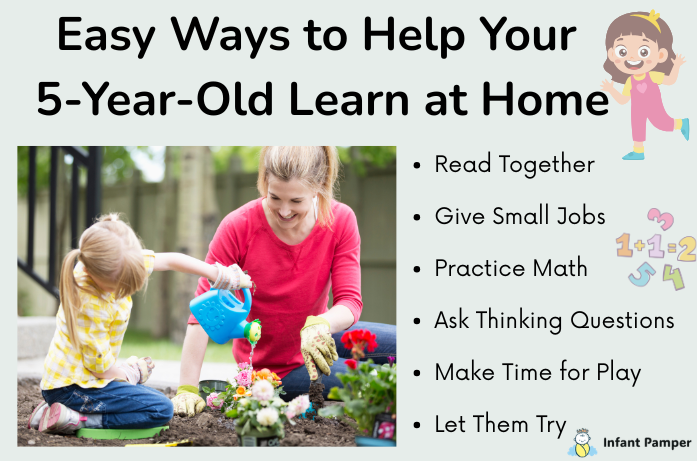
Easy Ways to Help Your 5-Year-Old Learn at Home
You do not need to turn home into a classroom. Five-year-olds learn best when learning feels natural, playful, and connected to everyday life.
1. Read Together Every Day
Spend 10 to 15 minutes reading with your child. Talk about the pictures, ask what they think will happen next, and let them retell parts of the story. This helps build vocabulary, attention, memory, and early reading skills.
2. Give Small Responsibilities
Simple jobs can teach independence and confidence. Let your child match socks, put toys away, carry napkins to the table, water a plant, or help pack their school bag.
3. Practice Math With Real Things
Count objects your child can see and touch, such as fruit, stairs, blocks, spoons, or toy cars. You can also compare which group has more, which object is bigger, or what happens when one item is taken away.
4. Ask Questions That Make Them Think
Instead of always giving the answer, ask questions like, “What do you think will happen next?” “Why do you think that happened?” or “How could we solve this?”
These simple questions encourage memory, reasoning, and problem-solving.
5. Make Plenty of Time for Play
Pretend play, building blocks, drawing, puzzles, dressing up, and outdoor games all support learning. Play helps children practice creativity, communication, social skills, movement, and problem-solving.
6. Let Them Try Before You Help
When your child is working on a zipper, shoes, puzzle, or simple task, give them a little time before stepping in.
Small struggles are part of learning. Trying, making mistakes, and trying again helps build patience, confidence, and independence.
When Should You Speak to Your Pediatrician?
Every child develops differently, but some concerns are worth discussing.
Talk with your pediatrician if your child:
- Loses skills they previously had
- Has major difficulty communicating
- Is very hard for familiar people to understand
- Rarely interacts with others
- Has trouble following simple directions
- Struggles significantly with everyday movement
- Has major difficulty with self-care
- Has learning or behavior that strongly concerns you
You do not need to know exactly what is wrong before asking.
Your pediatrician can help decide whether your child needs extra support or simply more time.
FAQs About 5-Year-Old Development
Final Thoughts
Understanding what should a 5 year old know can help you notice your child’s progress without turning development into a strict checklist. At five, learning includes much more than letters and numbers it also means building communication, confidence, independence, and social skills.
Some abilities will come quickly, while others need more time and practice. Keep reading together, talking, playing, and giving your child simple chances to try things on their own.
Focus on your child’s personal progress instead of comparing them with others. And if you ever feel concerned about their speech, learning, behavior, movement, or independence, talk with your pediatrician for guidance.
Explore more simple child development and parenting tips on Infant Pamper to support your little one’s learning and growth with confidence.
About the Author
Geeta Yogi is a parenting writer who shares practical guidance about child development, early learning, school readiness, behavior, and everyday parenting. Her writing focuses on helping parents understand age-appropriate milestones while supporting children through play, conversation, independence, and simple learning activities at home.