By a Caring Mom at Infant Pamper
If at any point you have found yourself in the center of your living room with a sobbing toddler and wondering Why Is My Toddler So Angry, you can be sure that you are not alone. I can recall a situation with my child when he got so mad just over the banana getting broken into two and I was in a state of confusion, fatigue plus I was feeling a little helpless as well. Toddlers are very emotional.
They are going through a lot and their world is very loud, fast, and unpredictable which may even become overwhelming sometimes. When they throw tantrums in a fit of anger, it can be treated as a personal failure but it is not. Your toddler is not “bad.” You are not doing anything wrong. This phase is emotional, disturbing, and very human. Let us take a tour of toddler rage giving love, science, and real-life parental experience.
Understanding Why Toddlers Get Angry So Easily
Toddlers have giant emotions trapped inside tiny bodies. Their brains simply aren’t ready to handle strong feelings.
The emotional part of children’s brain, the amygdala, is very active and sensitive while the logical part, the prefrontal cortex, is still growing.
Thus, toddlers are not able to control their reactions physically. The higher the emotions rise, the quicker the overflow.
They don’t feel the anger as a choice. They are going through a sea of feelings that they cannot even name. This is what most toddler anger problems and huge outbursts are based on.
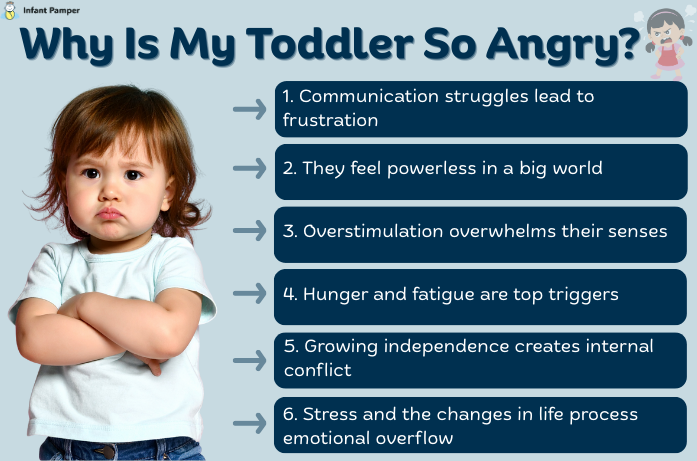
Why Is My Toddler So Angry?
The Real Reasons Behind the Meltdowns
This is, of course, the main question that every parent will eventually ask. However the answer is not straightforward, toddlers get mad for a variety of different reasons. Nevertheless, knowing the causes makes the behavior more manageable.
1. Communication struggles lead to frustration
The mind of a toddler may be of a greater capacity than his/her body can express. In those moments when they cannot speak their needs, they experience the feeling of being imprisoned. Consequently, they tend to release the built-up tension through actions such as hitting, yelling, or throwing around things.
Children who can’t speak or speak very little suffer even more from sadness because in their case their needs are unacknowledged.
2. They feel powerless in a big world
Toddlers are frequently deprived of making decisions. Their whole routine is governed by grown-ups, for instance, the very adults would even dictate what time they sleep and what they eat. Gradually this develops a feeling of defeat and then the anger erupts.
Introducing even basic options can often help in dealing with a lot of toddler temper problems.
3. Overstimulation overwhelms their senses
Lights, sound, screens, crowded areas, too many toys, even too much playing, and toddlers get overwhelmed quickly. The young kids are not that good in filtering sensory input according to the American Academy of Pediatrics.
And when they’re overstimulated, they explode.
4. Hunger and fatigue are top triggers
A child who doesn’t get enough food or rest will likely be emotionally intolerant. This is why tantrums tend to occur most often before naps, in the afternoon, and right before meals.
5. Growing independence creates internal conflict
The toddler is in the stage of wanting to be self-doers of anything and everything. But at the same time, his/her capabilities are not equal to his/her wants. The pull gets caught up. The footgear is not going to fit and therefore the puzzle will not fit.
Fuming can occur very soon after getting frustrated.
6. Stress and the changes in life process emotional overflow
Small changes, even those that are positive, can still be very hard for little brains to digest. The most common causes of increasing angry outbursts in children are the following:
- new sibling
- A new daycare center
- Big changes in the daily routine
- parents stressed or not paying attention
- Moving to a different house
- Too much time in front of the screen
For the toddlers, anger is often the sign of stress hiding through.
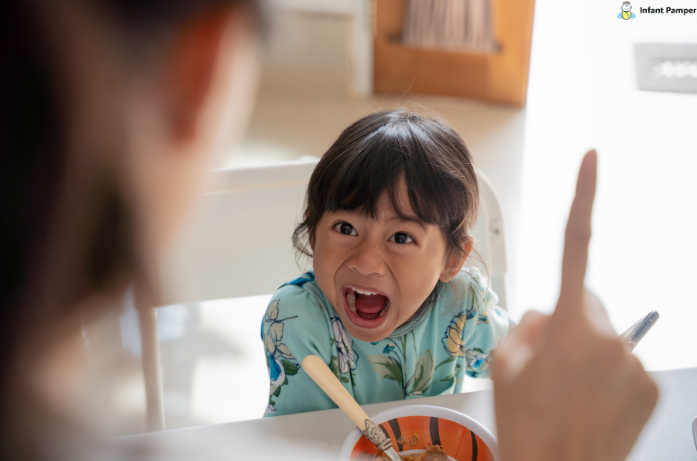
How Toddler Anger Shows Up (And Why It Feels So Extreme)
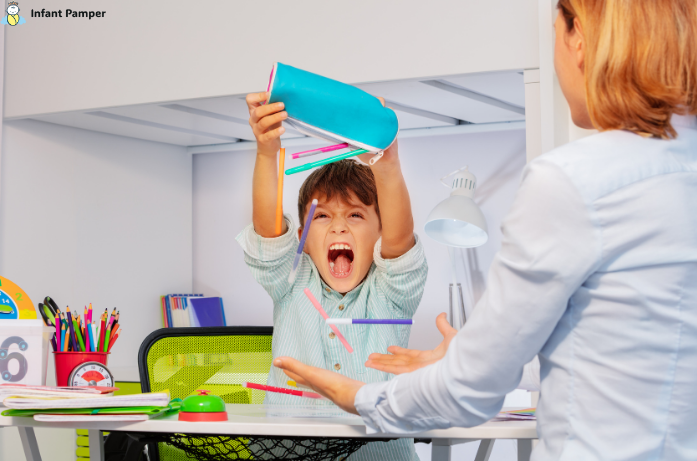
The anger of toddlers always manifests itself in an unkind way. It is noisy, when it is not dramatic, messy, and at times shocking.
Some actions that you may witness are:
- Yelling
- hitting or biting
- throwing of toys
- going down on the floor and lying down
- pulling of parents away
- saying no to everything (even to things they want)
- uncontrollable crying
These reactions may seem directed towards parents but they are not. They are just indications of kids being overwhelmed.
The more your child is overstimulated, the more the anger gets intensified.
Is This Normal Anger or Something More Serious?
An average toddler’s anger is totally normal, a developmentally natural process. But it is also important to see the signs when the anger might be an indication of something deeper.
Normal toddler anger includes:
- Fits of rage of 5-20 minutes duration
- Crying without control
- Hitting or biting occasionally
- Strong “NO!” responses
- Transitioning activities with difficulty
- Tantrums caused by hunger or tiredness
This type of anger normally diminishes as the child learns to express his/her feelings and thoughts better.
When anger may need attention:
Some actions can signal hidden more severe issues or even disorders regarding anger, especially if they occur frequently:
- meltdowns over 30-40 minutes long
- fighting several times a day
- inflicting pain on self or others severely
- extreme rage for minor annoyances
- anger with no obvious cause
- developmental and/or speech delays
- sensitivity to environmental factors such as noise, textures, clothing)
These are not diagnostic criteria; rather they are just indications that a child might require some assistance.
Getting professional advice as early as possible is a thoughtful and assertive parenting choice.
What’s Really Beneath a Toddler’s Anger?
Anger is mostly a top emotional layer that one can peel off. Children usually don’t get mad and experience pure anger; instead, they go through multiple:
- overwhelmed
- scared
- overstimulated
- disconnected
- confused
- sadness
- anxiety
- powerlessness
Toddlers turn to the vociferous anger to let if not all, a part of the puzzle of other feelings such as the aforementioned ones, out.
The knowledge of this fact makes it easier for parents to be more compassionate with their children instead of getting frustrated.
How to Respond Calmly When Your Toddler Gets Angry
Your child desires your tranquillity more than your dominance. Do not strive to be the perfect parent; just be there.
1. Acknowledge the Feeling
The act of mentioning the feeling of your little one will make something inside them to get gentle. It will assist them in feeling accepted, not alone in their rage. The uncomplicated expressions such as “This is very difficult for you,” or “You are very angry now,” will indicate to them that their feelings are rational.
It is not a must that you solve the issue straight away. Your compassion will in itself be the solace they are seeking.
2. Stay Calm Even When They Aren’t
This issue is very hard for all the parents. But your calm nervous system will show their confused body what regulation means. Toddlers cannot calm themselves down if the adult next to them is also angry.
When you reduce your breathing or make your voice softer, you are giving your kid an example of emotional control that they will gradually, but surely, grow into.
3. Present Relationship Before Correction
During difficult times, your child may not be willing to listen to rules or punishment. Instead, they will prefer bonding first. In some cases, this bonding can be demonstrated by gently touching, sitting quietly beside the child, or hugging the child.
When you choose connection over punishment, your child realizes that they will be more connected to you rather than being distanced from their feelings. Cooperation increases when a child feels safe.
4. Use Slow Transitions
Young children find change difficult because it distracts them from what they’re most focused on. Sudden changes can immediately trigger anger. That’s why soft countdowns are so effective.
When you say “five more minutes,” then “two more minutes,” the child’s mind gradually changes. When the child knows what’s coming next, they’ll resist less and throw a temper tantrum less often.
5. Teach Simple Calming Tools
No child knows how to calm themselves at a very young age; they have to go through a process to learn it. Anger management in very young children begins with very basic methods. Deep breathing, hugging a beloved toy, or cuddling a soft pillow can all be ways to relieve tension.
Some young children like their own little corner; others want you to hold their hand until they relax. These small, delicate techniques eventually become lifelong emotional skills.
Daily Habits That Prevent Toddler Anger Before It Starts
Daily Habits That Keep Toddler Anger at Bay Moms have confirmed these very simple and easy habits that can bring about a huge difference.
1. Daily connection time
Just 10 minutes of loving, distraction-free play can fill a child’s emotional tank. A connected child is also calmer.
2. Predictable routines
Routines are calming. When toddlers are aware of what is going to happen next, they get less angry.
3. Good sleep, good food, slow mornings
Tired, hungry, or hasty usually are the main causes of tantrums. Mornings with no rush and naps at the same time are very beneficial.
A toddler who is well-regulated is one who is also calm.
What NOT to Do During a Toddler Meltdown
Besides protecting the child’s mental health, responding in a particular way also prevents anger disorders in the long term.
- Do not shame the child.
- Do not say “Stop crying.”
- Do not give long lectures during the meltdown.
- Do not yell or threaten.
- Do not punish for emotions.
Your child should feel secure and not fearful.
When Toddler Anger Might Be a Symptom of Something Bigger
Emotional regulation can be difficult because of certain underlying conditions:
- delayed speech
- delayed development
- autism spectrum traits
- problems with sensory processing
- anxiety
- hearing issues
- trauma
- stimulation that is chronic
If the hard times are consistent in daily life, consult with your child’s doctor. You are not overreacting; you are taking care of your child.
Final Thoughts: Your Toddler Isn’t “Angry” They’re Learning
Your little one isn’t inherently angry. They’re angry simply because they’re human, a small, delicate, emotional creature who needs to understand how big the world is for them.
The question, “Why is my child so angry?” is largely about development. As children learn new vocabulary, patterns, and emotional regulation, their anger becomes less violent.
Your understanding serves as a refuge for them. Your joy is their support. Your love is their love nest. You’re doing better than you think, and your child is learning more than you can imagine.
For more heart-centered parenting advice, toddler behavior guides, and emotional support, visit Infant Pamper where real moms and real stories help you raise emotionally strong, happy little humans.
Frequently Asked Questions About Toddler Anger
1. Why is my toddler so angry all the time?
The cause is that their mind has not yet matured enough to handle strong emotions. Anger is the way they indicate frustration, fear, or being overwhelmed.
2. Are toddler anger issues normal?
Absolutely, the problem of toddlers’ anger is very common during the ages of 1-4. Their emotional development is quicker than their ability to control their emotions.
3. How can I help my toddler with anger management?
Be cool, identify their feelings, offer options, stick to the schedule, and show them easy calming techniques. These are the initial steps to training kids in anger management.
4. Could my toddler have anger disorders?
Genuine anger disorders are not common in kids. But very strong or long-lasting anger may warrant a visit to a professional for evaluation and ruling out of any medical conditions.
5. Do toddlers eventually outgrow this anger?
Of course. With the development of their language, brain, and emotional skills, the angry outbursts will decrease dramatically.
Disclaimer: This post is intended for educational and informative purposes only, and it should not be taken as a substitute for professional medical or psychological advice. In case your child’s anger is very strong, lasting or affecting his/her daily life, please, consult a pediatrician or child development expert.