Written by a caring mom at Infant Pamper
The beginning of solid food is an interesting time, but it means that your baby is likely to consume less breast milk and formula as they start tasting new foods. As a result, a question arises: do babies drink less after starting solids?
The answer is yes, as babies tend to decrease milk consumption due to an increase in solid food intake. Nonetheless, the CDC indicates that breast milk and baby formula will continue to be the main source of nutrition for infants in the first year of life. A small decline in milk intake is regarded as normal, but a sudden decrease or rapid drop may signal a problem.
By knowing how milk consumption changes with age and knowing how much milk your baby needs, as well as the point to start worrying, you can feel confident about this transition.
Do Babies Drink Less Milk After Starting Solids?
Yes. As babies become more comfortable eating solid foods, they will usually begin drinking somewhat less breast milk or formula.
But this transition happens over months, not overnight.
When solids are first introduced around 6 months, your baby may eat only a spoonful or two. At this stage, they are learning how to move food around their mouth, swallow different textures, and explore new tastes.
Milk still provides most of their nutrition.
As solid meals become larger and more regular later in infancy, your baby’s appetite for milk may naturally decrease. CDC guidance similarly explains that formula needs gradually decrease as babies eat more solids.
Why Milk Is Still Important After Starting Solids
It is easy to think that once a baby enjoys a bowl of oatmeal or mashed sweet potato, they no longer need quite as much milk.
But breast milk and infant formula still provide important energy, fat, protein, vitamins, minerals, and fluids throughout the first year.
Solid foods have a different role at first.
They help your baby get additional nutrients, especially nutrients such as iron and zinc, while also developing chewing, swallowing, self-feeding, and texture skills. Around 6 months, babies begin needing complementary foods in addition to milk because their nutritional needs are growing.
Think of it less as replacing milk and more as gradually building another important part of your baby’s diet.
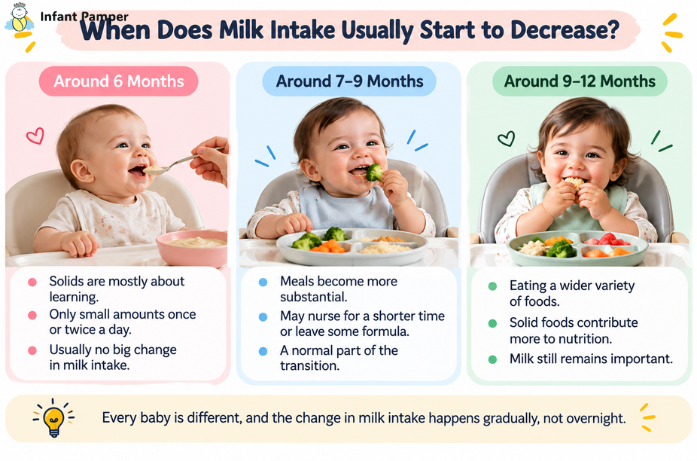
When Does Milk Intake Usually Start to Decrease?
There is no exact week when every baby suddenly begins drinking less.
Some babies love solids immediately. Others spend several weeks mostly touching, tasting, squishing, and dropping food on the floor.
Both can be normal.
Around 6 Months
At the beginning, solids are mostly about learning.
Your baby may eat only a small amount once or twice a day while continuing their usual breastfeeding or formula routine.
The CDC recommends beginning with small amounts and watching your baby’s hunger and fullness cues.
You may notice very little change in milk intake at this stage.
Around 7–9 Months
As your baby becomes better at swallowing and handling different textures, meals often become more substantial.
You might notice that they nurse for a shorter time or leave a little formula in the bottle after a good meal.
This can be part of the normal transition.
Around 9–12 Months
By this stage, many babies are eating a wider variety of foods and participating more regularly in family mealtimes.
Milk still remains important, but solid foods gradually contribute a larger share of their nutrition.
WHO recommends increasing the frequency and variety of complementary foods as babies get older while continuing milk feeding.
How Much Milk Should Baby Drink After Starting Solids?
Parents naturally want a number, but there is not one perfect amount for every baby.
Breastfed babies are especially difficult to measure because you usually cannot see exactly how much milk they drink.
Formula-fed babies may also take different amounts from one day to the next depending on growth, appetite, illness, teething, and how much solid food they have eaten.
Instead of focusing only on ounces, look at the bigger picture:
- Is your baby growing appropriately?
- Are they feeding willingly?
- Are they having regular wet diapers?
- Are they alert and active when awake?
- Are they gradually learning to eat different foods?
The CDC emphasizes responsive feeding because babies’ appetites and intake naturally vary.
If you are worried that your baby’s milk intake has dropped too much, your pediatrician can assess their growth and feeding history rather than relying on one daily number.
Should You Offer Milk or Solids First?
This often depends on your baby’s age and where they are in the transition.
When solids are brand new, offering breast milk or formula first can prevent your baby from becoming so hungry that they feel frustrated while learning to eat.
A very hungry 6-month-old may not be interested in patiently figuring out a spoonful of mashed avocado when they know milk satisfies them quickly.
Raising Children Network recommends offering early solid tastes when both parent and baby are calm and relaxed, often after a milk feed.
As your baby gets older and becomes a more established eater, feeding routines can gradually shift.
There is no need to force an exact schedule if your baby is growing well and responding normally to hunger and fullness.
A Simple Milk and Solids Routine
A flexible feeding routine can help your baby adjust to solids while continuing to get enough breast milk or formula.
A typical day for a baby around 6–9 months might include:
- Morning: Milk feed followed by a small breakfast.
- Mid-morning: Breast milk or formula.
- Lunch: Soft, iron-rich foods or mashed vegetables.
- Afternoon: Milk feed after a nap.
- Evening: A small dinner, depending on appetite.
- Bedtime: Breast milk or formula.
This is just an example, as younger babies may need fewer solid meals and more milk feeds.
According to the WHO, responsive feeding means following your baby’s hunger and fullness cues rather than forcing a strict schedule. Keep milk feeds available while gradually increasing solid foods.
How to Tell If Your Baby Is Full
Learning to recognize fullness cues can be especially helpful when solids begin.
Your baby may be telling you they have had enough if they:
- turn their head away
- close their mouth
- push the spoon away
- lose interest in the food
- become distracted
- lean away from the tray
Try not to sneak in “just one more bite.”
Allowing babies to respond to their own appetite can help make mealtimes calmer and teaches them that their fullness signals matter.
Raising Children Network also recommends following these cues rather than forcing food.
Why Your Baby May Suddenly Drink Much Less Milk
Sometimes solids are not the only reason your baby’s milk intake changes.
A temporary reduction can happen because of:
Teething: Sore gums can make sucking uncomfortable for some babies.
Illness or Congestion: A blocked nose, sore throat, fever, or upset stomach can temporarily affect feeding.
Too Much Food Before Milk: If your baby fills up on a large serving of solids shortly before their usual bottle or breastfeed, they may naturally drink less.
Too Much Water: A little water can be introduced with meals once solids begin, but water should not crowd out breast milk or formula during infancy.
Distraction: Older babies suddenly notice everything around them.
A feeding that once happened quietly can become far more interesting when there is a sibling, toy, dog, television, or conversation nearby.
Growth and Appetite Changes: Babies do not eat exactly the same amount every day. Their appetite may increase during some periods and decrease during others.
One lighter feeding day is usually less important than the overall pattern.
A Common Mistake: Increasing Solids Too Quickly
It can be exciting when your baby enjoys food, especially after weeks of throwing most of it on the floor.
But bigger portions are not always better.
If solid meals become very large too quickly, some babies may fill their small stomachs before getting enough breast milk or formula.
Start with small portions and let your baby show you when they want more.
The CDC suggests beginning with just 1–2 tablespoons and increasing gradually according to hunger and fullness cues.
Choose Nutrient-Dense Foods, Not Just Filling Foods
This is an area parents sometimes overlook.
As solid foods begin contributing more to your baby’s diet, the quality and variety of those foods become increasingly important.
Try to include foods that provide more than just calories.
Good options may include:
- iron-fortified infant cereal
- well-cooked egg
- soft meat or poultry
- fish prepared safely
- lentils and beans
- tofu
- plain full-fat yogurt
- avocado
- vegetables
- fruits
- whole grains
Iron deserves particular attention because babies’ stored iron begins declining around the time complementary foods are introduced. Raising Children Network specifically recommends including iron-rich first foods.
What About Water After Starting Solids?
Once your baby begins solids around 6 months, you can introduce small amounts of water with meals.
This helps them practise drinking from an open or straw cup and become familiar with water.
But water should not replace milk feeds.
CDC guidance says babies aged 6–12 months can have breast milk or formula along with limited amounts of water.
If your baby starts drinking a lot of water while refusing breast milk or formula, talk with your pediatrician about the best balance.
Can Cow’s Milk Replace Formula After Starting Solids?
No, cow’s milk should not replace breast milk or formula before your baby turns 12 months old. Although babies can usually enjoy dairy foods like plain yogurt and cheese after starting solids around 6 months, cow’s milk is not suitable as their main drink during the first year.
According to the CDC, cow’s milk does not provide the right balance of nutrients for babies under 12 months and may increase the risk of iron deficiency.
After your baby’s first birthday, you can gradually introduce pasteurized whole cow’s milk as a drink while continuing to offer a balanced diet. Breastfeeding can also continue beyond 12 months if you choose.
How Do I Know My Baby Is Getting Enough?
Rather than measuring every spoonful and ounce, look at your baby’s overall wellbeing.
A reassuring pattern usually includes steady growth, regular wet diapers, normal energy, interest in feeding, and ongoing developmental progress.
Raising Children Network also points to wet diapers, alertness, satisfaction after feeds, and appropriate weight gain as useful clues that a baby is getting enough nutrition.
Your pediatrician can use your baby’s individual growth curve to provide more personalized guidance than a generic feeding chart.
When Should You Contact Your Pediatrician?
A gradual decrease in milk intake as solids increase can be completely normal.
A sudden or significant change is different.
Contact your baby’s healthcare provider if your baby:
- repeatedly refuses breast milk or formula
- has noticeably fewer wet diapers
- seems unusually sleepy or weak
- is vomiting repeatedly
- struggles to swallow
- seems to be losing weight or not growing as expected
- develops feeding difficulties that continue
- appears unwell or dehydrated
For a young baby, it is always reasonable to contact your pediatrician when something about feeding feels very different from your baby’s usual pattern.
Frequently Asked Questions
1. Do babies drink less milk after starting solids?
Yes, milk intake may gradually decrease as babies eat more solids, but breast milk or formula remains essential throughout the first year.
2. Is it normal for a 6-month-old to drink less milk?
A slight decrease is normal, but solids should not replace several milk feeds at this age.
3. Should I reduce formula when starting solids?
No, there is usually no need to reduce formula immediately. Follow your baby’s hunger and fullness cues.
4. Can babies drink water after starting solids?
Yes, small amounts of water can be offered with meals from around 6 months.
5. When do solids become more important than milk?
Solid foods gradually become more important, with family meals taking a larger nutritional role around 12 months.
When do solids become more important than milk?
The balance changes gradually throughout the second half of the first year. Around 12 months, family foods begin playing a much larger role in your child’s overall diet.
Final Thoughts
Starting solids is an exciting milestone, and babies drinking less milk after starting solids is usually normal when the change happens gradually. However, breast milk or formula remains an important source of nutrition throughout the first year.
Focus on offering nutritious foods, following your baby’s hunger and fullness cues, and monitoring their growth, wet diapers, and overall health. Every baby adjusts to solids at their own pace.
If your baby’s milk intake suddenly drops or you notice signs of poor feeding, consult your pediatrician. With patience and a balanced feeding routine, you can support your baby’s healthy transition to solid foods.
Looking for more helpful baby feeding tips? Explore Infant Pamper for practical feeding guides, nutritious baby food ideas, and expert-backed parenting advice to support your little one’s healthy growth.
Disclaimer
This article is for general educational purposes and is not a substitute for personalized medical or feeding advice from your child’s pediatrician or registered dietitian.