Written by a Caring Mom at Infant Pamper
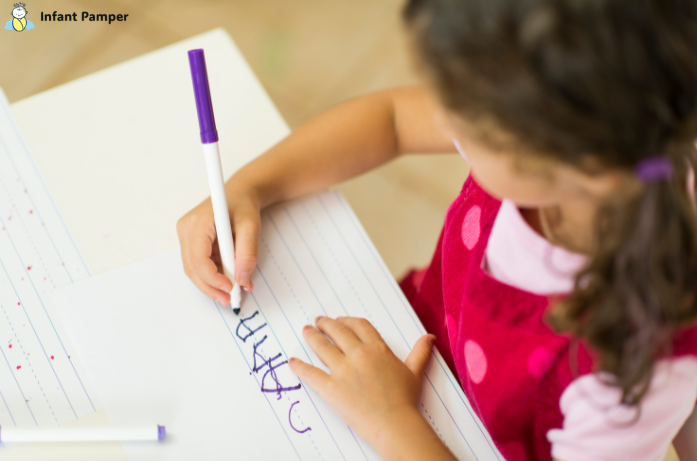
It is always such a sweet moment when your preschooler starts making little marks on paper. Maybe it is a circle, a funny face, or a few lines they proudly call their name. These small attempts may look simple, but they are actually the first steps toward learning to write.
Pre-writing activities help children build the hand strength, control, and coordination they need before they start writing letters properly. The best part is, it does not have to feel like schoolwork. Simple things like playdough, chalk, stickers, toy cars, painting, and drawing can all help your child practice while having fun.
At this age, there is no need to rush. A little practice, lots of play, and gentle encouragement can help your preschooler feel more comfortable and confident with writing.
Table of Contents
- Why Pre Writing Skills Matter
- Pre-Handwriting Skills Start With Play
- 20 Fun Pre Writing Activities for Preschoolers
- Easy Prewriting Activities Preschool Kids Can Do at Home
- A Simple Pre-Writing Progression
- Which Lines and Shapes Should Children Practice First?
- How Do I Know My Preschooler Is Ready for More Pencil Practice?
- Frequently Asked Questions
- Final Thoughts
- Disclaimer
Why Pre Writing Skills Matter
Learning to write starts with much more than holding a pencil. Before children can form letters, they need enough strength and control in their hands and fingers to make small, careful movements.
Pre writing skills help build this foundation through everyday play. Activities like rolling playdough, threading beads, drawing lines, and tracing simple shapes can improve hand strength, coordination, and control.
These skills can make writing feel easier and less tiring later. At the preschool stage, the main goal is not neat handwriting. It is helping your child feel comfortable and confident using crayons, pencils, and other drawing tools.
The CDC’s developmental milestones for 4-year-olds also notes that many children around this age begin holding a crayon or pencil between their fingers and thumb and may draw a person with three or more body parts.
Pre-Handwriting Skills Start With Play
Children do not build writing skills only by holding a pencil. Many everyday play activities help strengthen the shoulders, arms, wrists, hands, and fingers that are needed for comfortable handwriting later.
Simple things like climbing, crawling, throwing a ball, stacking blocks, pushing toys, or painting on an easel can all support pre handwriting skills. These activities help children improve strength, balance, coordination, and control without making it feel like a lesson.
So if your preschooler prefers active play over tracing worksheets, that is completely fine. They may still be building the physical skills that will make writing easier when they are ready.
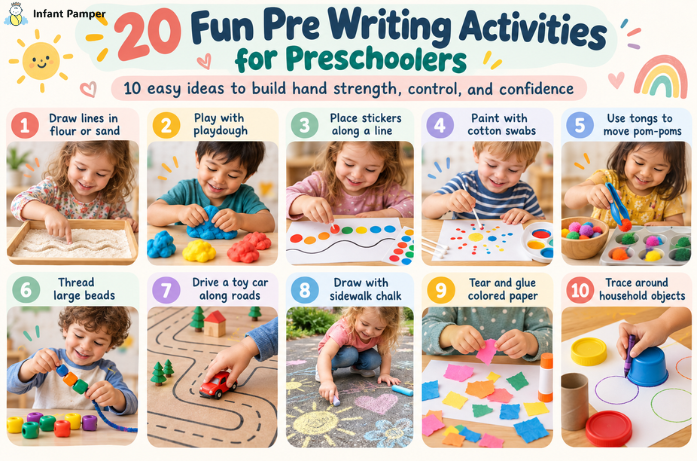
20 Fun Pre Writing Activities for Preschoolers
These activities are simple, low-cost, and easy to do at home. Choose a few your child enjoys and repeat them during the week.
Short, playful practice is usually enough. The goal is to build hand strength, control, and confidence without making it feel like homework.
1. Draw in a Flour or Sand Tray
Pour a little flour, salt, semolina, or sand into a shallow tray. Let your child draw lines, circles, waves, and zigzags with one finger.
It is a fun way to practice early writing movements. If they make a mistake, just smooth the tray and start again.
2. Play With Playdough
Let your child squeeze, roll, pinch, and flatten playdough. They can make balls, snakes, or simple shapes.
These movements help strengthen the fingers and hands needed for holding crayons and pencils.
3. Make Sticker Lines
Draw a straight, curved, or zigzag line on paper. Ask your child to place stickers along the line.
Peeling and placing stickers helps improve finger control and hand-eye coordination.
4. Paint With Cotton Swabs
Give your child a cotton swab and washable paint. Let them make dots, circles, lines, or simple pictures.
The small tool encourages careful finger movements while still feeling like a fun art activity.
5. Use Tongs to Move Objects
Place pom-poms or other safe objects in one bowl and ask your child to move them with child-friendly tongs.
This helps strengthen the thumb and fingers and improves control.
6. Thread Large Beads
Give your child large beads or chunky pasta and a thick string. Let them thread the pieces one by one.
This activity encourages both hands to work together and supports hand-eye coordination. Always supervise small pieces.
7. Draw Roads for Toy Cars
Draw simple roads with curves, turns, and straight lines on a large sheet of paper.
Let your child drive a toy car along the road. This helps them practice following a path and controlling hand movement.
8. Use Sidewalk Chalk
Give your child chunky chalk and let them draw big circles, lines, rainbows, or roads outside.
Large movements can be easier for preschoolers and help prepare the arms and hands for smaller writing movements later.
9. Tear and Glue Paper
Let your child tear colored paper into small pieces and glue them onto another sheet.
Tearing works the fingers, while placing and gluing the pieces helps with coordination.
10. Trace Around Household Objects
Use cups, lids, cookie cutters, or blocks for tracing.
Your child can hold the object with one hand and trace around it with the other, helping both hands work together.
Easy Prewriting Activities Preschool Kids Can Do at Home
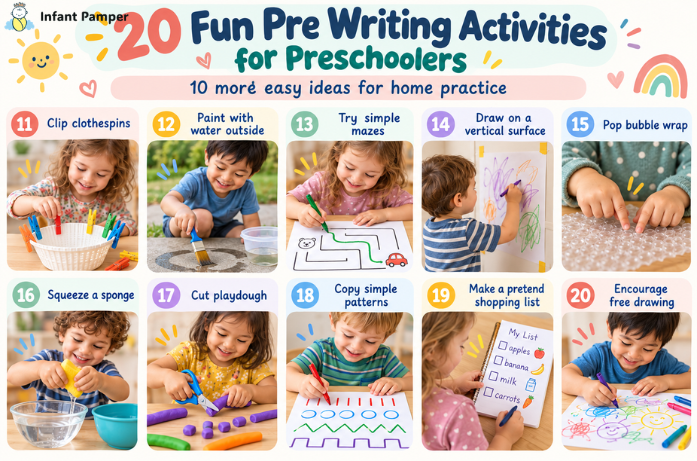
These activities can easily fit into everyday play. They do not need to feel like lessons.
A few minutes at a time is enough, especially for younger preschoolers.
11. Clip Clothespins
Let your child clip clothespins around a basket, box, or paper plate.
Opening and closing the pegs helps strengthen the thumb and fingers.
12. Paint With Water Outside
Give your child a bowl of water and a paintbrush. Let them paint lines, circles, or shapes outside.
The marks disappear as they dry, so your child can practice again and again.
13. Try Simple Mazes
Choose beginner mazes with wide paths. Let your child first trace the path with a finger.
Later, they can try using a crayon to practice controlled movement and direction.
14. Draw on a Vertical Surface
Tape paper to a wall, easel, or refrigerator and let your child draw while standing.
This encourages different shoulder, arm, and wrist movements than drawing at a table.
15. Pop Bubble Wrap
Let your child pop clean bubble wrap using their fingertips.
You can also draw a line over it and ask them to follow the line while popping the bubbles.
16. Squeeze a Sponge
Fill one bowl with water and leave another empty. Let your child move the water by squeezing a sponge.
This simple activity helps build strength in the whole hand.
17. Cut Playdough
Roll playdough into long snakes and let your child cut them with age-appropriate safety scissors.
This is often easier than cutting paper and helps improve hand strength and coordination.
18. Copy Simple Patterns
Start with easy patterns such as straight lines, circles, or slanted lines.
For example:
| | |
○ ○ ○
/ / /
Ask your child to copy the pattern underneath.
As they get more comfortable, you can try waves, loops, crosses, and simple shapes. This is a fun way to practice prewriting activities before moving on to letters.
19. Make a Pretend Shopping List
Give your child a small notebook during pretend grocery play and let them make their own list.
Scribbles, lines, and pictures are all fine. This helps children understand that writing can represent ideas and words.
Research published in the National Library of Medicine found that shared writing activities with parents can give preschoolers meaningful practice with early literacy, language, and fine-motor skills.
20. Encourage Free Drawing
Keep crayons, paper, and washable markers where your child can easily reach them.
One of the easiest pre writing activities for preschoolers is simply giving children time to draw without correcting every line. Free drawing helps build confidence and creativity.
A Simple Pre-Writing Progression
You do not need a complicated developmental chart.
A simple way to think about early writing is:
big movements → hand strength → scribbling → lines → shapes → patterns → letters
These stages often overlap.
Your child might be learning circles while still strengthening their hands with playdough.
That is completely normal.
There is no need to wait until one skill is perfect before trying another.
Which Lines and Shapes Should Children Practice First?
Before formal letters, start with simple movements.
Try:
- vertical lines
- horizontal lines
- circles
- crosses
- diagonal lines
- squares
- simple curves
- triangles
Keep the shapes large at first.
Smaller patterns can come later as your child develops more control.
How Do I Know My Preschooler Is Ready for More Pencil Practice?
Your child may be ready for a little more structured drawing when they:
- enjoy scribbling or drawing
- try to copy simple lines
- show interest in letters
- can sit for a few minutes without becoming frustrated
- begin drawing circles or recognizable shapes
- use crayons with increasing control
You do not need all these signs at once.
Watch your child and follow their interest.
What If My Child Hates Tracing Worksheets?
Not every preschooler enjoys tracing worksheets, and that does not mean they are not learning. Some children understand early writing movements better through hands-on play than through pencil-and-paper tasks.
You can try drawing lines in flour, painting with water, making roads for toy cars, or building shapes with playdough. These activities still teach children how to guide their hands, follow a path, and control movement.
Worksheets are only one tool. For many children, pencil work feels easier after they have first built strength and confidence through play.
Try This Simple 5-Minute Routine
You do not need long practice sessions to support early writing skills. A few minutes of playful activity can be enough, especially for younger preschoolers.
You could try:
Monday: Playdough
Tuesday: Chalk drawing
Wednesday: Sticker lines
Thursday: Water painting
Friday: Free drawing
Short and regular practice helps children build skills without feeling tired or pressured. It also makes it easier to keep writing practice part of a normal daily routine.
Pre K Writing Activities Should Still Feel Fun
When trying pre k writing activities, it is important to keep expectations realistic. Preschool handwriting is still developing, so lines may be shaky, circles may be uneven, and letters may sometimes appear backward or too large.
Instead of focusing only on neatness, notice the effort your child is making. You can say, “You worked really carefully on that,” or “I can see how much you were concentrating.”
Positive feedback helps children feel confident and willing to keep practicing. At this stage, enjoying the process is often more important than producing perfect letters.
A Quick Note About Pencil Grip
Young children often use different pencil grips while their hands are still developing. Their grip may change naturally as their finger strength and control improve.
Instead of correcting their fingers every time, offer plenty of activities that build fine-motor strength, such as playdough, cutting, stickers, chalk, tongs, and drawing. Short crayons or small pieces of chalk can also encourage children to use their fingers more carefully.
If your child regularly seems uncomfortable when drawing, avoids using one hand, struggles with simple hand movements, or you have concerns about their development, it is a good idea to speak with your pediatrician or another qualified professional.
Frequently Asked Questions
Final Thoughts
Learning to write is a process, and it starts with many small moments of play. Rolling playdough, drawing with chalk, tearing paper, tracing shapes, and making simple marks all help your child build the skills they will use later.
You do not need to push for perfect letters or turn every activity into a lesson. A little practice, plenty of encouragement, and time to explore are often enough.
With regular pre writing activities, your child can slowly build stronger hands, better control, and more confidence. Let them enjoy the scribbles, the messy drawings, and the small improvements along the way. All of it is part of learning.
Looking for more simple parenting and preschool tips? Explore more helpful guides on Infant Pamper to support your child’s learning and development.
Disclaimer
This article is for general informational purposes only. Every child develops at their own pace. If you have concerns about your child’s fine-motor skills, handwriting development, or overall progress, speak with a pediatrician, teacher, or qualified professional.
About the Author
Geeta Yogi is a parenting writer who shares practical ideas about preschool learning, fine-motor development, creative play, and everyday activities for young children. Her writing focuses on helping parents support early skills through simple, playful experiences that build confidence without unnecessary pressure.