Written by a Caring Mom at Infant Pamper
Three months is such a wonderful age. At this age, your baby becomes more alert and active. They smile more, look at your face and start noticing small events that happen around them. Moreover, kicking, hand actions and first efforts to grasp something close appear at three months.
The appropriate choice of toys for 3 month old babies will promote this development in a subtle way without overloading the baby with activities.
The good thing about this stage is that the baby does not require lots of toys. Soft rattles, baby-proof mirrors, cloth books or simple mats are enough to entertain and develop your baby. The most important thing is to be next to your baby while he plays.
Table of Contents
What Is a 3-Month-Old Learning During Play?
At around three months, babies start becoming more aware of their hands, feet, sounds, faces, and objects around them.
They may begin watching moving toys, briefly holding something placed in their hand, bringing their hands to their mouth, kicking more strongly, or trying to swipe at something above them.
According to Mayo Clinic, by the end of the third month many babies are gaining better control of their hands, may grasp toys and bring them toward their mouth, and can become better at following moving objects with their eyes.
These little movements may not seem like much, but they are part of early development.
Play at this age is not about teaching your baby to use a toy correctly. It is simply about giving them safe opportunities to discover what they can see, hear, touch, and do.
10 Best Toys for 3 Month Old Babies
The best toys at this stage are usually simple, lightweight, easy to clean, and safe for little hands. Look for toys that encourage basic skills like looking, listening, reaching, grasping, and moving.
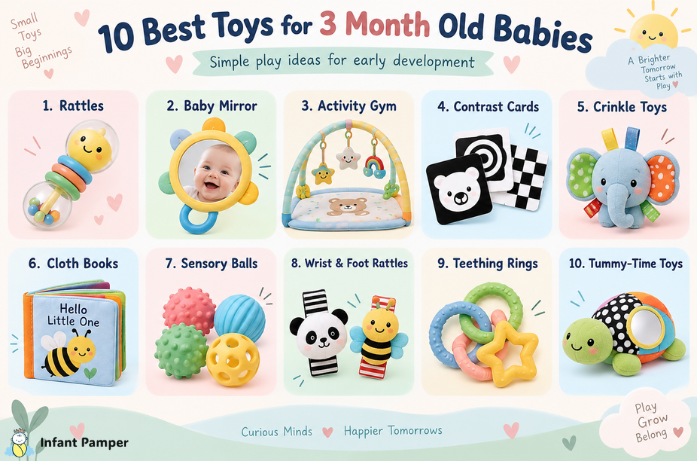
1. Lightweight Rattles
A lightweight rattle is one of the most useful toys for three month old babies. Choose one that is easy to hold and makes a soft, gentle sound.
Shake it slowly from side to side or place it in your baby’s hand for a few seconds. Even brief holding helps them practice early grasping and hand control.
2. Baby-Safe Mirror
Babies love looking at faces, which makes a baby-safe mirror a lovely tummy-time toy. Place an unbreakable mirror in front of your baby while they are awake and supervised.
They may smile, stare, or lift their head for a better look. You can also sit nearby and talk softly while they watch the reflection.
3. Activity Gym
An activity gym is one of the most practical 3 month old baby toys because it encourages both reaching and kicking.
Hanging toys give your baby something to watch and swipe at while lying on their back. Keep the setup simple, because too many lights, sounds, and toys can feel overwhelming.
4. High-Contrast Cards
High-contrast cards are a simple choice for quiet play. Bold patterns and clear shapes can be easier for young babies to notice.
Hold one card where your baby can see it comfortably, then slowly move it from side to side. Give them time to look instead of switching images too quickly.
5. Crinkle Toys
Crinkle toys are fun because they make a gentle sound when touched or squeezed. At first, your baby may make the sound by accident.
Later, they may try touching the toy again. Choose a soft, washable version without loose decorations or small parts.
6. Soft Cloth Books
Soft cloth books are useful toys for 3 months old babies because they combine pictures, textures, and sounds in one simple toy.
You can turn the pages, point to pictures, and talk about what you see. Your baby may not understand the words yet, but hearing your voice supports bonding and early communication.
7. Easy-Grip Sensory Balls
A soft sensory ball can encourage reaching and early grasping. Choose one that is large enough to be safe and easy for little fingers to touch.
Place it close to your baby’s hands during floor play. Over time, you may notice those accidental touches turning into more purposeful reaching.
8. Wrist and Foot Rattles
Soft wrist or foot rattles can help babies notice their own movements. A little kick or wave may create a sound that catches their attention.
Use them only during awake, supervised play. Make sure they fit comfortably and are never tight around your baby’s wrists or ankles.
9. Soft Teething Rings
Many babies start bringing their hands and toys toward their mouth around this stage. A soft teething ring can give them something safe to hold and explore.
Choose one that is lightweight, easy to clean, and designed for young babies. It can support grasping, touching, and safe mouth exploration.
10. Soft Tummy-Time Toys
Tummy time can be challenging for some babies, so placing an interesting toy in front of them can help.
A soft animal, mirror, fabric toy, or colorful object may encourage your baby to lift their head and look forward. As your baby becomes stronger, you can also try simple activities that help your baby roll from tummy to back while keeping tummy time playful and supervised.
How to Choose the Right Toy
One easy way to choose toys for a 3 month old is to think about what your baby can actually do with them. A few simple toys are usually enough.
The American Academy of Pediatrics, also recommends choosing toys that match a child’s current developmental abilities while giving them opportunities to practice new skills.
- For looking and tracking: Choose a baby-safe mirror or high-contrast cards.
- For listening: Try a lightweight rattle with a soft, gentle sound.
- For grasping: Pick an easy-grip sensory ball or soft teething ring.
- For reaching and kicking: An activity gym with a few hanging toys works well.
- For tummy time: Place a mirror, soft toy, or colorful object in front of your baby.
- For sensory play: Use soft crinkle toys or textured cloth books.
You do not need several toys that do the same thing. A few well-chosen options can support different types of play as your baby grows.
Try One Toy in Different Ways
You do not need a new toy for every type of play. Sometimes one simple toy can keep your baby interested in several different ways.
Take a rattle, for example. Let your baby look at it first, then shake it gently so they can hear the sound. After that, place it close enough for them to touch or hold for a few seconds.
You can do the same with a soft cloth book. Show the pictures, let your baby feel the texture, and use it during tummy time. It is a simple way to make play more interesting without buying more toys.
Free Play Ideas Your Baby May Love
Some of the sweetest playtime moments do not need toys at all. Your baby loves watching your face, listening to your voice, and noticing how you respond to them.
Try singing a gentle song, copying their little coos, smiling back when they smile, or talking to them during diaper changes and getting dressed. These simple everyday moments can be just as interesting to your baby as any toy.
These everyday interactions matter too. The CDC encourages parents to talk, sing, read, respond to their baby’s sounds, and play when their baby is alert and relaxed.
How Long Should a 3-Month-Old Play?
There is no set amount of playtime that works for every 3-month-old. Some babies stay interested for several minutes, while others get tired or distracted much sooner.
Follow your baby’s cues instead of watching the clock. Smiling, kicking, looking at a toy, and making happy sounds usually mean they are enjoying themselves. If they start looking away, yawning, fussing, or crying, it may be time for a cuddle, feeding, quiet time, or nap.
How Many Toys Does a 3-Month-Old Need?
Probably fewer than you think.
A simple collection might include:
- one lightweight rattle
- one baby-safe mirror
- one cloth or crinkle book
- one activity gym
- one easy-grip sensory toy
You can add or rotate toys over time as your baby’s interests change.
There is no need to put everything on the floor at once.
Try keeping three or four toys available and storing the others.
After a few days, switch one or two.
Sometimes a toy your baby ignored last week suddenly becomes very interesting.
Safety Tips for Baby Toys
Before handing over a new toy, it is worth giving it a quick safety check. Nemours Kids Health recommends following age guidelines and regularly checking baby toys for loose, broken, sharp, or small parts that could become unsafe.
- Check the age recommendation: Choose toys that are suitable for your baby’s age and stage of development.
- Avoid small or loose parts: Stay away from tiny pieces, loose buttons, beads, or anything that could come off and become a choking hazard.
- Look for smooth edges: Toys should not have sharp corners, rough surfaces, or broken parts.
- Keep strings short: Avoid toys with long cords, ribbons, or strings that could wrap around your baby.
- Choose easy-to-clean toys: Since babies often put toys in their mouths, pick items that can be washed or wiped regularly.
- Inspect toys often: Check for cracks, loose stitching, broken pieces, or other damage before playtime.
- Supervise play: Stay close during tummy time and whenever your baby is trying a new toy.
- Keep it simple: A toy does not need flashing lights or loud sounds to support development. Simple, safe toys can be just as engaging.
Frequently Asked Questions
Final Thoughts
At three months, play is less about having lots of toys and more about giving your baby simple chances to look, listen, reach, grasp, kick, and explore. A rattle, mirror, soft book, or activity mat can all support these early skills when used in a calm, supervised way.
Follow your baby’s cues and keep playtime flexible. Some days they may enjoy reaching for a toy, while other days they may prefer watching your face or listening to your voice. Both are valuable parts of development.
Most importantly, choose safe, age-appropriate toys and enjoy the small moments. Your talking, smiling, cuddling, and playing together are just as important as the toys themselves, and these everyday interactions help make playtime meaningful.
Explore more simple baby activities, development tips, and age-appropriate play ideas on Infant Pamper to make everyday moments with your little one more meaningful.
Disclaimer
This article is for general informational purposes only and is not a substitute for medical advice. Every baby develops differently, so speak with your pediatrician if you have concerns about your baby’s development or toy safety.
About the Author
Geeta Yogi is a parenting writer who shares practical guidance about baby development, age-appropriate play, infant milestones, and everyday baby care. Her writing focuses on helping parents choose simple, safe activities that support early skills while keeping playtime relaxed and enjoyable.