By a Caring Mom at Infant Pamper
Children learn to share through practice, just as adults do. If you watch two young children scramble for the same toy at the same time, you’ll understand that sharing isn’t a habit, but a skill that needs to be learned. In a preschool environment, children don’t always understand why they should give up what they want most or why they should consider another child’s feelings at that moment. That’s why sharing activities for preschoolers children are so important. They help them practice waiting their turn, working together, and building empathy in a fun and safe way.
I’m a mom and I’ve witnessed arguments over crayons, blocks, and picture books many times. I’ve come to the conclusion that sharing isn’t just a nice behavior. It’s a social milestone. Children at this age are learning to control their impulses and understand that other people have thoughts and feelings. When combined with the right activities, loving guidance, and a consistent routine, children will become more considerate, cooperative, and confident playmates.
The activities below are ideal for your home, preschool class, or casual playdates. Each one incorporates child development concepts and real-life parenting experiences to help your child become more patient, understanding, and socially confident.
Why Sharing Feels Difficult for Preschoolers
For adults, sharing may be a small expectation, but for preschoolers, it often becomes a huge deal. Their world is full of exciting things and deep emotions, and their most precious possessions are almost like a part of their identity. Letting them go, even for a short while, can feel like a loss or a setback.
Developmental professionals explain that this behavior is an important part of growing up. The pathways states that children learn social norms through real-life situations, not just by being told them. This means that children won’t start giving away their things just because they’re told to; they need to experience such situations daily and engage in friendly interactions with others to learn them.
During this time, children are building a strong emotional foundation for patience, self-control, understanding, and teamwork. These qualities don’t come quickly. A schedule of structured social activities for preschoolers helps them better understand their own and others’ emotions and learn to handle shared spaces more peacefully.
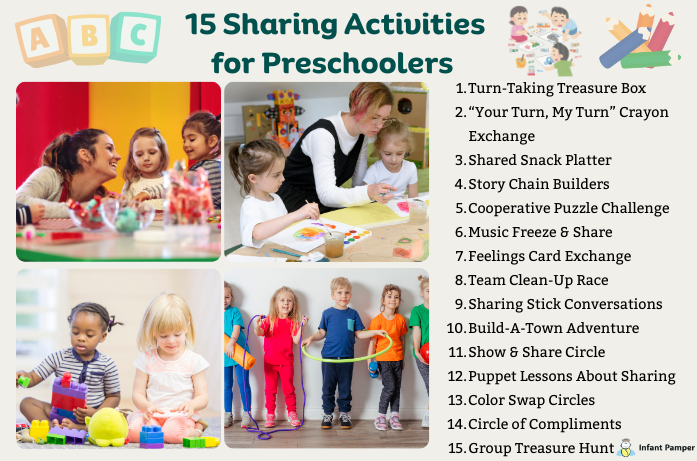
15 Sharing Activities for Preschoolers
The following activities are thoughtful, developmentally suitable, and engaging for young children, helping sharing feel natural, fun, and cooperative.
1. Turn-Taking Treasure Box
Get a small container filled with fascinating toys, puppets, soft blocks, toy cars, or sensory items. Ask the kids to take one item, explore it briefly, and then pass it to the next person before picking another one.
This calm rhythm helps kids learn that everyone gets a chance, and that play can be non-competitive and cooperative.
2. “Your Turn, My Turn” Crayon Exchange
When children are coloring, let them each take one crayon at a time at first. After a short period of coloring, you can ask them to switch crayons with a classmate. This keeps them interested and prevents frustration.
This exercise teaches children the lesson of sharing through the power of repetition. Items are exchanged frequently; therefore, children don’t feel any loss; they are already confident that their turn will come soon.
3. Shared Snack Platter
Place small snacks, such as pieces of fruit or crackers, on a plate right in the middle of the table. Children are allowed to take one piece at a time and then pass the plate to the next child.
In addition to self-control, this activity also teaches fairness and cooperation when eating. Children will understand that whoever is in charge of the group will be the first to bring food to everyone.
4. Story Chain Builders
Gather a small group of children and tell a story in a simple sentence, then ask the next child to add a second sentence. The unpredictable nature of the story keeps everyone engaged.
This activity not only promotes language development but also instills the patience needed to actively listen and wait for others to speak.
5. Cooperative Puzzle Challenge
Break apart a large puzzle and give each child a few pieces to work with. Children will have to talk to each other to figure out where each child’s piece fits into the puzzle.
Building something together is a lot of fun. Children will realize that working together not only makes things easier but also more fun. This is a simple yet very effective way to teach teamwork and support each other.
6. Music Freeze & Share
Turn on some happy music and let the kids dance however they want. When the music stops, they have to find a partner and share a funny move, smile, or sound they find amusing.
This fun game fosters friendships and, as a byproduct, teaches children to view sharing as a fun activity rather than a chore. It’s also a perfect choice for sharing games for kindergarteners who are constantly looking for fun physical movements and fast-paced activities.
7. Feelings Card Exchange
Create cards that display different emotions: happy, sad, excited, worried, and surprised. Ask every kid to select a card and then talk about a moment they felt like that.
This exercise allows kids to communicate their emotions and to recognize that feelings are the same all over the world. Moreover, talking about the past makes children more compassionate and this very trait reinforces their willingness to share.
8. Team Clean-Up Race
Form small groups of children and assign each group a different cleanup job, that is, blocks, books, dolls, or crayons. The whole group’s effort turns cleanup from a boring task to a fun mission.
Team spirit not only promotes collaboration but also aids the little ones to discover that working together for a common cause yields greater results.
9. Sharing Stick Conversations
A simple stick can be made beautiful with colors, ribbons, or glitter. The person holding the stick will be the one to speak and will be the one to suggest the next activity.
When he/she is through, he/she passes it on. In this way, children learn to listen to others with respect and develop patience. The physical move of passing the stick makes taking turns very clear and easy to understand.
10. Build-A-Town Adventure
Arrange blocks, toy buildings, cars, and human figures. Children are invited to create a town together. They will have to talk about the streets, the location of houses, and the movement of cars. Kids acquire the skills to negotiate and appreciate to share creativity.
Togetherness becomes the main ingredient of the activity and the final town symbolizes the collaboration done.
11. Show & Share Circle
Instead of the usual “show and tell” approach, have children bring a small object and then discreetly pass it around the group for others to see.
This builds trust and self-efficacy, especially in children who are timid or hesitant to participate. A child who learns to let others have possession of their treasure for a while strengthens their ability to wait and share.
12. Puppet Lessons About Sharing
Puppets can illustrate characters’ problems in the sharing aspect by performing small stories, e.g. two puppets want the same cookie or both want the same seat.
Children react with laughter, make connections, and absorb the lesson without feeling pressured. Role-play helps kids to recognize feelings and social difficulties from a safe distance, thereby making it easier for them to apply the lesson in real life.
13. Color Swap Circles
Each child should be given two different colored pom poms or paper balls. Then have them switch colors with a partner and continue until everyone has switched things at least a few times.
This small but essential sharing activity is great for young children because it’s quick, easy, and easy to do. Even the youngest children develop their ability to work together through repetitive and predictable movements.
14. Circle of Compliments
Have the children stand in a circle and ask them to take turns complimenting the person next to them. Sayings like, “I enjoyed playing with you today” or “You’re a great assistant” are sweet and effective.
This not only builds empathy and bonding, but also helps children use their words positively, which helps build good relationships.
15. Group Treasure Hunt
Small objects are to be hidden throughout the room or courtyard. Children are to search for the items, but instead of keeping everything they find, they are to put everything in a single “treasure basket.” After collecting all the items, they can sort them and play together.
This changes the mindset from “mine” to “ours,” making working together beneficial.
Making Sharing Part of Everyday Life
Sharing is not a short-term process but rather a gradual one that lasts through consistent, calm everyday experiences. Here are some gentle ways to support your child:
- Play fair with each other during simple routines such as turning TV shows or pushing elevator buttons.
- Discuss feelings in times of disagreement so that the kids are aware of both sides of the matter.
- Exemplify sharing in your own personal life. The kids learn the most through what they witness every day.
- Do not hurry or compel your child to share at once. Waiting for a turn is felt to be fairer than giving up a toy too soon.
Gradually, these habits will transform children’s sharing from a chore to a part of life.
Simple kitchen activities can also encourage patience, following directions, and independence. As your little one becomes more confident with self-feeding, try these nutritious homemade recipes like Broccoli Puree and Prune Puree.
When Do Children Truly Learn to Share?
The first signs of sharing are most common in preschoolers between four and five years old, but true understanding usually comes gradually, usually around age six or seven. These age differences are quite significant. The Edutopia information shows that social-emotional abilities develop at different times in different children.
The ability to share may come naturally to some children, while others will need repeated demonstrations and patient guidance through the process. This struggle isn’t a sign of failure; it simply means the child is growing.
Don’t forget that sharing isn’t a test. It’s an often hard-won social skill that lasts a lifetime and requires repeated support with love and kindness.
Conclusion
The term sharing may seem insignificant, however, it indicates a major portion of the children’s social and psychological growth. Through these preschoolers’ sharing activities, on one hand, you are developing taking turns and on the other hand, you are nurturing empathy, patience, cooperation, and even strong early friendships in your child.
By sharing with love, equal treatment, and thoughtful activities, children begin to see being together, doing good, and behaving well as more fun than being selfish. Today’s small actions are the building blocks for tomorrow’s adults who are caring and, of course, socially confident.
FAQs on Sharing Activities for Preschoolers
1. Why is sharing so difficult for preschoolers?
Sharing is difficult because preschoolers are in the process of gaining self-control and understanding the feelings of others. They should practice this instead of forcing it.
2. How can I teach my child to share without forcing it?
Take turns gradually, demonstrate sharing practices yourself, and validate your child’s feelings. Children learn to share by recognizing and supporting their emotions.
3. What are some easy sharing activities for toddlers?
Very small activities like rolling a ball, changing colors, or sharing a toy for a short while are some ways to help toddlers practice sharing in a very short, fun time.
4. At what age do children typically start sharing well?
Most children begin sharing between the ages of 3-5, but a full understanding of this concept usually comes around the age of 6-7, when children become more adept at socialization and emotional understanding.
5. Are sharing games also useful for kindergarten children?
Absolutely. Sharing games are an important aspect of kindergarten children’s education because they help develop qualities like cooperation, waiting, communication, and strong bonds of friendship.
Ready to help your little one build stronger social skills? Explore more gentle parenting tips and activity guides on Infant Pamper and make learning fun every day!